
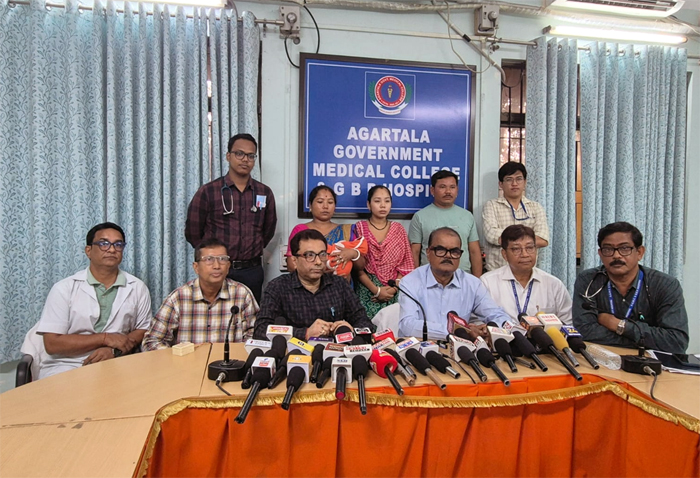
A three-day-old newborn suffering from a rare congenital condition has been given a new lease of life after doctors successfully performed a highly complex surgery through a coordinated, multidisciplinary effort by doctors of Agartala Government Medical College (AGMC) and GB Hospital.
The infant was unable to swallow milk or even saliva soon after birth. Medical examinations revealed that the baby had Esophageal Atresia (EA) and Tracheoesophageal Fistula (TEF)—a rare congenital abnormality in which part of the esophagus is absent and an abnormal connection develops between the food pipe and the windpipe. As a result, the child was unable to feed normally, while stomach contents also posed a risk of entering the lungs, causing breathing difficulties.
Doctors said surgery is the only effective treatment for such a condition. Following the successful operation, the baby's health has steadily improved. The newborn is now able to feed normally, has started gaining weight, and is expected to be discharged after a few more days of observation and intensive care.
According to the medical team, the diagnosis was made after paediatricians and members of the neonatology team noticed the baby's symptoms soon after birth. Led by Dr. Shivaji Das, the team suspected the rare disorder and confirmed it through X-rays and other diagnostic investigations. The doctors emphasized that timely suspicion and early diagnosis are critical in managing such complex congenital conditions.
After confirming the diagnosis, specialists from the Departments of Paediatrics, Cardiovascular and Thoracic Surgery (CTVS), Anaesthesiology, and Neonatology jointly planned the surgical procedure as well as the post-operative care required for the infant.
The doctors described the surgery on the three-day-old newborn as extremely challenging. Since the baby's airway was also affected, administering anaesthesia required exceptional precision and caution. Anaesthesiologists Dr. Rimjhim Chakma and Dr. Monimoy were responsible for safely managing this crucial aspect of the procedure.
The operation lasted nearly two-and-a-half to three hours. Through a thoracic approach, surgeons first identified and reconstructed the esophagus, enabling food to pass normally into the stomach. They also separated the abnormal connection between the esophagus and the trachea before reconstructing the airway. Given the tiny size of the infant's organs, the entire procedure demanded extraordinary surgical precision.
Following the operation, the baby was shifted to the Neonatal Intensive Care Unit (NICU), where doctors and healthcare staff from the Paediatrics and Neonatology departments provided round-the-clock monitoring and intensive post-operative care. The infant's condition gradually improved and the baby is now feeding independently and steadily gaining weight.
Expressing satisfaction over the successful outcome, the doctors said the achievement was the result of teamwork rather than the effort of any single individual. They credited the seamless coordination among multiple departments and expressed confidence that the child would make a full recovery and lead a normal life.
The surgeons also noted that they have prior experience in performing such rare procedures, including several similar surgeries at a private hospital in Tripura. They added that a comparable operation had previously been carried out at IGM Hospital as well.
The successful diagnosis, surgery and post-operative management of the three-day-old newborn represent a significant milestone for healthcare in Tripura. Beyond bringing hope to the infant's family, the achievement highlights the growing expertise and collaborative capabilities of the state's medical professionals.