
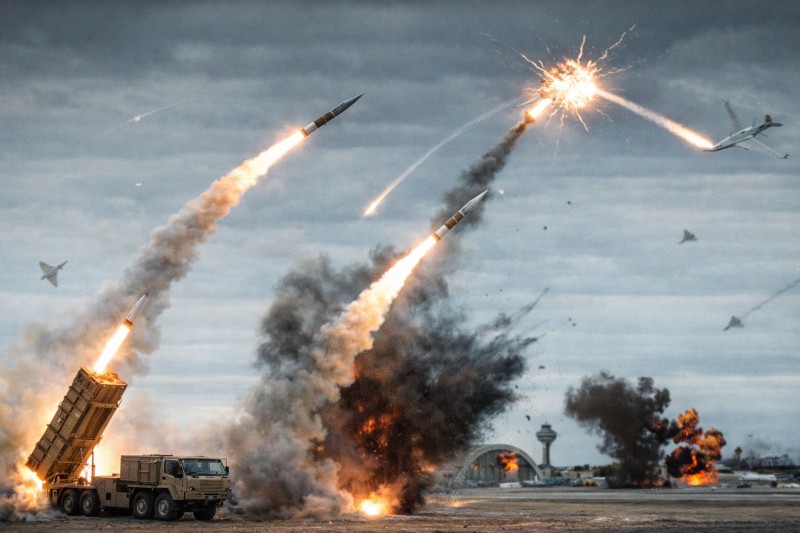
Each launch carries not just explosive force but economic consequence. Iran’s strategy has turned into a stark equation: $20,000 one-way drones against $4 million interceptor missiles.
Three days into the fighting, the confrontation has assumed the character of attritional warfare.
Iran has launched repeated waves of drones and missiles against US and allied positions stretching from Bahrain to the United Arab Emirates.
The United States and its regional partners have responded with advanced air defence systems, intercepting the majority of incoming threats. Yet the deeper question is no longer about accuracy. It is about endurance.
Shahed-136 and logic of low-cost saturation
Iran’s principal tool in this phase of the conflict is the Shahed-136, a rudimentary but effective one-way attack drone.
Tehran has fired more than 1,200 projectiles since hostilities escalated, many of them believed to be Shaheds.
These drones have targeted US bases, oil installations and civilian infrastructure following US and Israeli air strikes on Iranian facilities.
The Shahed is inexpensive, relatively easy to produce and designed to overwhelm defences through volume.
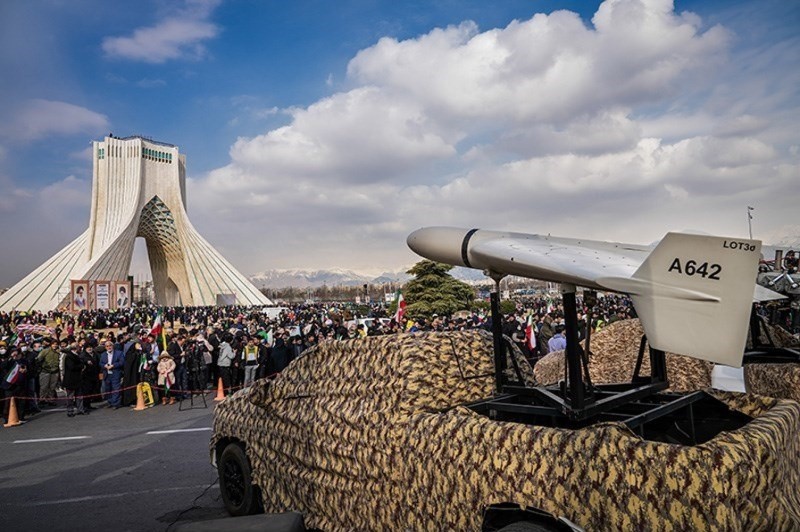 A Shahed-136 loitering munition on a launcher in a pickup truck displayed during the 44th Islamic Revolution anniversary ceremony in Tehran, Feb 11, 2023. Photo: Wikimedia Commons/Tasnim News Agency/Meghdad Madadi
Military analysts argue that Iran’s aim is not necessarily to penetrate every shield but to force defenders to expend costly interceptors in large numbers.
The United Arab Emirates has reported interception rates exceeding 90 percent against Shaheds and ballistic missiles.
The primary defensive system has been the US-made Patriot platform, developed by RTX Corporation and firing PAC-3 interceptors produced by Lockheed Martin. Each PAC-3 missile costs roughly $4 million.
The imbalance is stark. A relatively cheap drone can compel the launch of a missile costing hundreds of times more.
Stockpiles under strain
The financial disparity is compounded by production limits.
Lockheed built around 600 PAC-3 missiles in 2025, despite efforts by the Pentagon to accelerate output.
Given the scale of reported interceptions since the weekend, analysts estimate that thousands of interceptors may already have been fired across the region.
Qatar reportedly faces a particular strain.
An internal analysis cited by Bloomberg suggested that Doha’s Patriot interceptor stocks could last only four days at current usage rates.
Qatari officials, however, have publicly denied any depletion, stating that inventories remain well-stocked.
Saudi Arabia and the UAE also operate the THAAD system, another Lockheed product designed to intercept high-altitude ballistic threats.
THAAD interceptors cost roughly $12 million each and are typically reserved for more advanced missiles rather than drones.
US forces have supplemented these systems with fighter patrols deploying Advanced Precision Kill Weapon System missiles, each costing between $20,000 and $30,000, though jet operating expenses significantly increase the total cost per engagement.
Iran’s calculated attrition strategy
Analysts describe Tehran’s approach as deliberate. Kelly Grieco of the Stimson Centre argues that attrition makes operational sense for Iran.
By sustaining drone and missile pressure, Tehran hopes to exhaust interceptor inventories and test the political resolve of Gulf states hosting US assets.
Iran’s conventional air defence capacity has suffered. Early in the conflict, US and Israeli strikes targeted surface-to-air batteries, including Russian-supplied S-300 systems.
Since then, US and Israeli aircraft have reportedly operated in Iranian airspace with little resistance.
Iran’s regional proxy networks were also weakened during the Gaza war and in a previous 12-day confrontation in June.
That earlier campaign reportedly damaged Iranian missile capabilities and eliminated multiple launchers.
Israeli officials claim they have destroyed approximately 150 launchers in the current fighting, reducing Iran’s ability to sustain high-volume barrages.
Nevertheless, Tehran retains significant capacity. Before this year’s escalation, Iran was estimated to possess around 2,000 ballistic missiles.
Analysts believe Tehran holds a much larger stock of Shahed drones, which Russia has also manufactured at scale.
Becca Wasser of Bloomberg Economics suggests that Iran may be conserving more advanced ballistic missiles for prolonged engagement, relying initially on drones to probe and exhaust defences.
Coordination and command dynamics
Iranian Foreign Minister Abbas Araghchi indicated that military units are operating with a degree of autonomy under pre-issued directives.
His remarks to Al Jazeera suggested limited real-time coordination between battlefield commanders and civilian leadership.
On the American side, planning timelines may also prove decisive. President Donald Trump has suggested that operations could continue for several weeks.
However, analysts question whether sufficient munitions were pre-positioned to sustain high-intensity strikes for that duration.
US Defence Secretary Pete Hegseth emphasised that the campaign would not resemble prolonged conflicts such as Iraq, underscoring Washington’s desire to avoid open-ended engagement.
Risk of mutual exhaustion
If Iranian drone launches continue at their current tempo, Patriot and other interceptor stockpiles in the region could decline rapidly.
Conversely, Iran’s own missile and drone inventories may also dwindle under sustained counterstrikes and launcher destruction.
Ankit Panda of the Carnegie Endowment for International Peace notes that the likely outcome, based on the war’s initial hours, may be stalemate rather than decisive victory.
Both sides could find themselves constrained by production capacity rather than battlefield tactics.
The conflict has exposed a central dilemma of modern air defence.
Advanced interceptors remain essential against sophisticated ballistic threats, yet they are ill-suited to counter swarms of low-cost drones at scale.
Purpose-built anti-drone technologies, including laser systems such as Israel’s Iron Beam, offer potential long-term solutions, but they have not yet defined this battlefield.
For now, the struggle continues in the balance between cost and capacity as Iran’s missile math has turned the war into a contest of inventories.