
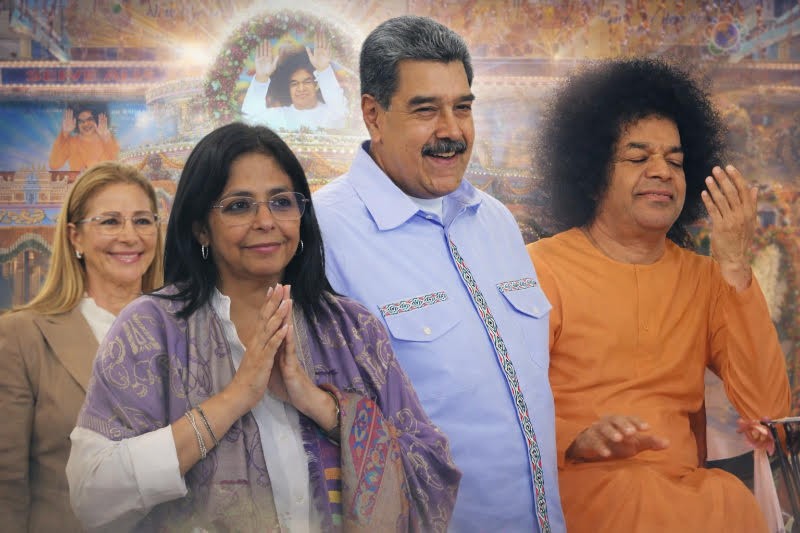
As Maduro awaits trial in New York on narco-terrorism charges, archived images, official records, and public statements have resurfaced, revealing a spiritual connection that spans two decades and continues to influence Venezuela’s political elite.
Adding to the intrigue is the fact that Venezuela’s acting president, Delcy Rodríguez, is also a committed devotee of Sathya Sai Baba, having made multiple pilgrimages to the guru’s ashram in Andhra Pradesh in recent years.
Maduro’s journey from Catholic roots to Eastern spirituality
Born into a working-class family in Caracas and raised Catholic, Maduro’s spiritual evolution took a decisive turn in 2005.
Then serving as Venezuela’s foreign minister, he travelled quietly to Puttaparthi, Andhra Pradesh, accompanied by his wife Cilia Flores, to seek the blessings of Sathya Sai Baba at the Prasanthi Nilayam ashram.
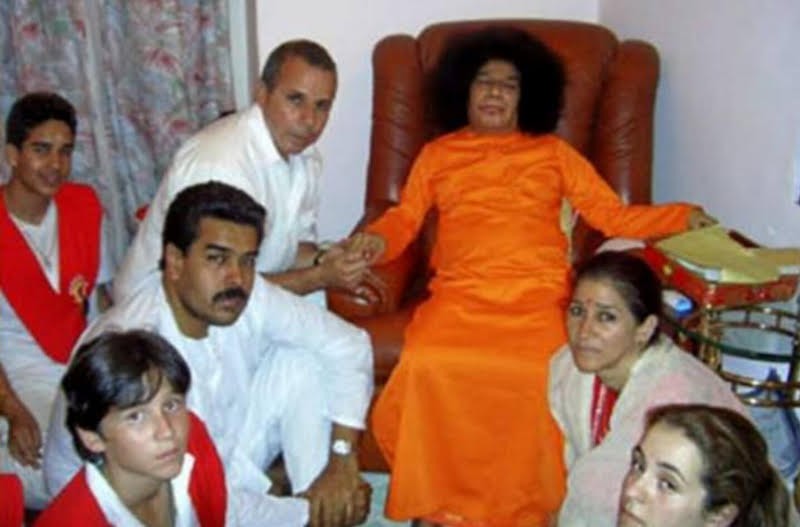
Rare photographs from the visit show Maduro seated humbly on the floor, listening attentively to the Indian guru.
The visit was reportedly arranged through Flores, herself a long-time devotee, and marked the beginning of what insiders describe as a “family faith” that would remain central to Maduro’s personal life even as his political power grew.
Sai Baba’s presence inside Venezuela’s presidential palace
Maduro’s devotion did not end with his India visit.
As he rose to the presidency following Hugo Chávez’s death in 2013, a framed portrait of Sathya Sai Baba occupied a prominent place in his private office at Miraflores Palace, displayed alongside revolutionary icons Simón Bolívar and Chávez.
According to multiple accounts, Flores often invoked Sai Baba’s teachings on patience, destiny, and service during moments of political crisis, including coup attempts and mass protests.
The spiritual bond reportedly served as a source of emotional grounding during periods of intense international pressure on the regime.
A unique national tribute after Sai Baba’s death
When Sathya Sai Baba passed away in April 2011, Venezuela became the only Latin American nation to issue an official condolence resolution through its National Assembly.
Under Maduro’s influence as foreign minister, the country declared a day of national mourning, formally recognising the Indian spiritual leader’s contribution to humanity.
Years later, on November 23, 2025, just weeks before his capture, Maduro publicly commemorated Sai Baba’s centenary.
In an official statement, he described the guru as a “being of light” and recalled their meeting with reverence, calling it one of his most meaningful personal experiences.
Delcy Rodríguez: Acting President and fellow devotee
Beyond Maduro, devotion to Sathya Sai Baba runs deep within Venezuela’s current leadership.
Acting President Delcy Rodríguez has visited Prasanthi Nilayam at least twice in recent years—once in August 2023 and again in October 2024—according to statements from the Sathya Sai Central Trust.
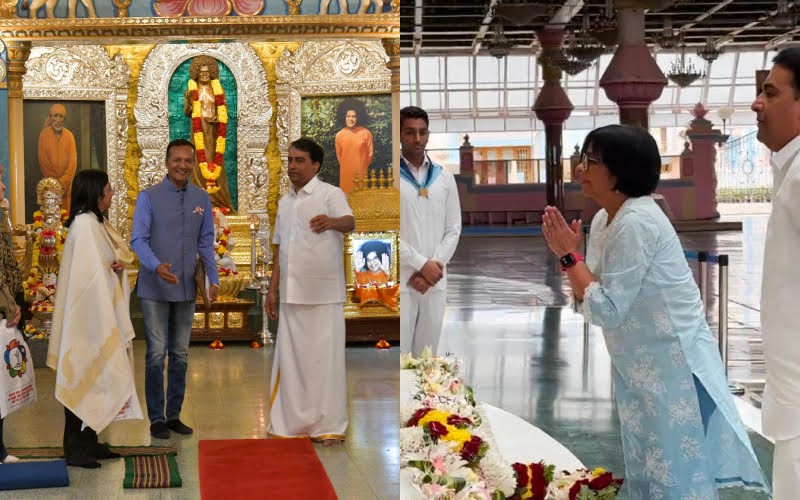
During these visits, Rodríguez spent time at the Samadhi Mandir and Shanthi Bhavan, expressing deep joy and tranquillity.
Her pilgrimages were described as personal, even when they coincided with official diplomatic engagements in India, including the G20 Summit.
The Sai movement’s deep roots in Venezuela
Venezuela holds a distinctive place within the global Sathya Sai movement, which is active in 113 countries.
The first Sai Centre in the country was established in Caracas in 1974, following visits by early devotees to Puttaparthi in the early 1970s.
Over the decades, the Sai organisation expanded its presence across Venezuelan cities, operating schools, Institutes of Human Values, and medical camps.
Notably, Sai Centres continued functioning freely even as the Maduro regime expelled several foreign NGOs—underscoring the privileged status the movement enjoyed.
Faith, power, and a stark contradiction
Sathya Sai Baba’s core teachings emphasise truth, righteousness, non-violence, and service.
Yet Maduro now faces serious allegations of narco-terrorism and violent repression in US custody—a contradiction that has drawn global attention.
As legal proceedings unfold, the story of a captured authoritarian leader and his enduring devotion to an Indian spiritual guru adds a complex, almost paradoxical layer to Venezuela’s political saga—one now shared by the country’s acting president as well.