
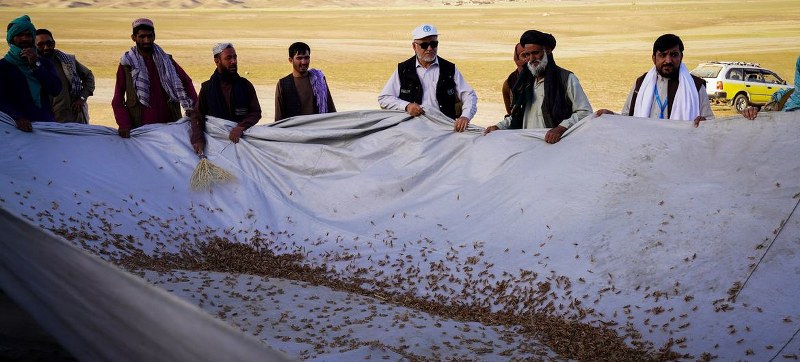
The UN’s Food and Agriculture Organization (FAO) sounded the alarm on Wednesday after locusts were spotted in the country’s north and northeast. FAO said that a “full outbreak” this year could destroy up to 1.2 million metric tonnes of wheat, or a quarter of the total annual harvest.
FAO Representative in Afghanistan Richard Trenchard said that together with partners, the agency was racing to help reduce the impact of the outbreak.
With pesticides in short supply, thousands of people in communities across the affected provinces were working “day and night” to eradicate the pests using “traditional mechanical control methods” before they become adults and begin to swarm, he said.
Left untreated, the Moroccan Locust population could increase 100-fold in the next year, according to FAO.
Earlier this year, the UN World Food Programme warned that six million Afghans were one step away from famine.
‘Huge concern’
Sightings of locusts at different development stages have been made in Badakhshan, Badghis, Baghlan, Balkh, Kunduz, Samangan, Sar-e-Pul and Takhar, with fresh reports coming in from Heart and Ghor provinces.
“The reports of Moroccan Locust outbreak in Afghanistan’s wheat basket is a huge concern”, said Mr. Trenchard.
“The Moroccan locust eats more than 150 species of plants, including tree crops, pastures and 50 food crops, all of which grow in Afghanistan. It represents an enormous threat to farmers, communities and the entire country,” he added.
He noted that the last two big infestations which took place 20 and 40 years ago, cost the country an estimated 8 per cent, and 25 per cent of production.
“Harvest forecasts this year are the best we have seen for the last three years – but this outbreak threatens to destroy all these recent gains and dramatically worsen the food insecurity situation later this year and into next year,” the FAO Representative continued.
The Moroccan Locust is ranked among the most economically damaging plant pests anywhere in the world, and the value of the potential loss, adds up to between $280 million and a staggering $480 million, going by today’s prices, FAO warned.
The agency said that the year had seen “perfect” conditions for a locust outbreak so far, in the north and northeast, with over-grazing, drought and very limited control measures, creating an “ideal environment for locusts to hatch and swarm.”
Swinging into action
“The alarm bells rang late, but FAO, its incredible NGO partners, local communities and local authorities sprang into immediate action,” said Mr. Trenchard.
“Chemical supplies were low across the country so we were forced to focus on traditional ‘mechanical control’ methods to reduce the impact of the outbreak.”
He said that cash-for-work had been a way “to put money into the pockets of farmers most at risk while accelerating mechanical control in communities across the North and Northeast regions”, and there had been “a strong, rapid and encouraging response from the Ministry of Agriculture, Irrigation and Livestock, although their capacity to respond is heavily constrained by a lack of resources”.
Ominous threat
Typically, after decimating pasture, large locust hopper bands and adult swarms move down to cropland areas and eat rain-fed and irrigated wheat and other crops.
FAO warned that there is not a single crop which is spared from Moroccan Locust damage.
If numbers do increase up to 100-fold, it would create even bigger problems for agriculture and food security in Afghanistan, and neighbouring countries.
If the Moroccan locust population is left untreated, it could increase its numbers by 100-fold in the next year, creating even bigger problems for agriculture and food security for Afghanistan and that of its neighbours.
“Chemical control methods are far more effective than mechanical control”, said Mr. Trenchard.
“Afghanistan used to have a very strong locust control system in place. But this has been heavily eroded in the last two years. At this point in time, all we can hope is that the mechanical control approaches will reduce the overall impact of the swarms. But we must start now to prevent 2024 from seeing even bigger outbreaks”, he concluded.