
Named after the flowers civilians stuffed in the muzzles of the soldiers’ guns, the revolution put Portugal on the path to democracy and led to the independence of its six remaining colonies, stretching from Africa to the Pacific, with ripple effects in Brazil – independent since 1822, but under military rule at the time.
UN Secretary-General António Guterres, a former Portuguese Prime Minister, argues that from a historical perspective, the uprising “should have occurred decades earlier.”
Reflection and analysis
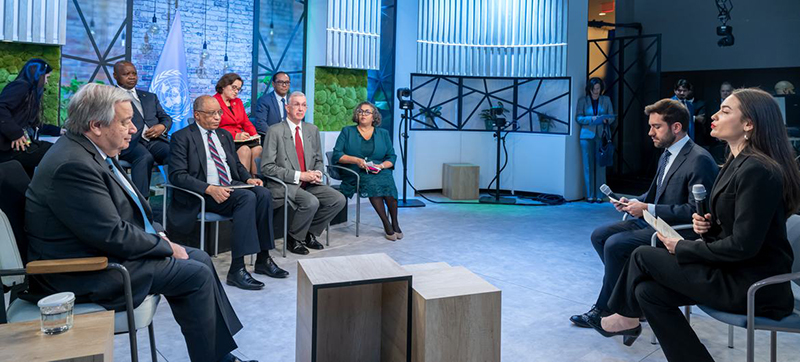
Ahead of the 50th anniversary of the revolution, which is also known as 25 April, Guterres and UN Ambassadors from Portuguese-speaking countries sat down to reflect on its significance and implications today.
Participating in the debate were the Permanent Representatives of Angola, Brazil, Cabo Verde, Mozambique, Portugal and Timor-Leste. Their countries are all members of the Community of Portuguese Language Countries (CPLP), established roughly a decade after the revolution. Other members include Guinea-Bissau and the island nation of São Tomé and Príncipe.
UN News’s Portuguese team organized the high-level discussion, moderated by journalists Marta Moreira from Portugal and Felippe Coaglio from Brazil.
The debate will be broadcast by media outlets throughout the Lusophone world. Globally, roughly 250 million people speak Portuguese.
'On the right side of history'
Having experienced the events of the Carnation Revolution firsthand, Mr. Guterres declared that “being on the side of freedom against oppression” means being on the right side of history.
“It is clear that we are on the right side of history, freeing a country from dictatorship, and we are on the right side of history re-establishing justice in international relations after a colonial past that is unacceptable,” he said.
The UN chief declared that 25 April would not have occurred “without the struggle of the African liberation movements”. For him, “the two things are interconnected and that is why there is no cause-and-effect relationship”.
In this regard, Mr. Guterres noted that if there were any criticism of 25 April, it would be that “from a historical point of view, it should have happened decades earlier.”
Catalyst for independence
The Permanent Representative of Angola, Francisco José da Cruz, stated that the Carnation Revolution was of great importance to Angolans as it created the dynamics that led to the country's independence.
“Portugal's desire to move forward in this process became clearer when the Secretary-General of the United Nations, Kurt Waldheim, visited Portugal in August, and Portugal made it clear that this would be the path to follow and that the liberation movements would be the legitimate interlocutors in this process that would lead to independence,” he said.
Brazilian Ambassador Sérgio Danese said 25 April had two main impacts on South America’s largest country. The first was to show that “there was hope” for a path towards democratic rule once again and the second was in diplomacy.
“We had a very strong contradiction in our foreign policy. We recognized the independence of all former French, British and Dutch colonies, but we remained tied to Portuguese colonialism, and the 25th of April and its immediate consequences promptly freed us from that yoke," he recalled.
“We were the first country to recognize Angola. And then we were among the first to recognize each of the former Portuguese colonies,” he added.
A deep friendship
When asked what helped shape new relations between the Portuguese-speaking nations, the Ambassador of Cabo Verde, Tânia Romualdo, highlighted the relationship between their populations as the basis for the bond between the emerging States.
“This revolution made it possible not to begin, but to continue this deep friendship that united peoples,” she said. “There was a union there, a very strong friendship, that preceded the revolution itself which contributed to the revolution and which helped the decolonization process after 25 April to accelerate bilateral cooperation”.
Among the issues raised during the debate was how Portuguese-speaking countries have much in common, despite their different paths to democracy and nationhood.
Unity and fraternity
Ambassador Pedro Commissar of Mozambique highlighted how the Lusophone bloc is defined by ties of proximity and solidarity with the United Nations. Mozambique is currently the only Lusophone country on the 15-member UN Security Council, occupying one of the 10 seats allotted to non-permanent members.
“The CPLP is a totally different model from the Commonwealth or Francophonie model. It is a model of sovereign States but linked by a bond of deep fraternity. 25 April gave us that basis, that impulse so that today we have this affection that unites our countries,” he said.
On this issue, the Ambassador of Portugal, Ana Paula Zacarias, pointed to ongoing efforts on the diplomatic front to amplify their common voice, in Portuguese, at the UN. She emphasized that some of their common positions are already being heard in the General Assembly and the Security Council.
“Being heard means working together - and working together in areas that have already been identified,” she said. “Above all, we have a lot to do in political coordination, in coordinating security and defense issues which are currently fundamental. And everything that has to do with the fight against climate change.”
The Representative of Timor-Leste, Dionísio Babo Soares, spoke of reinforcement at an internal and external level to boost future action as a bloc in a world marked by complexities in politics and development.
“For Timor-Leste, the CPLP is an entry point to the world. Member countries are located in different parts of the world,” he said. Furthermore, efforts to reintroduce the Portuguese language in Timor-Leste are intensifiying.
“We work together with Portugal in this sense, and we are committed to moving forward with this programme of having Portuguese as the official language of the United Nations”.
‘Symbol of peace’
Looking to the future, Guterres characterized the cooperative relations that exist today between Portuguese-speaking countries as a “symbol of peace” that should inspire the world.
The Secretary-General expressed hope that the bloc “can play a decisive role in re-establishing the trust that has unfortunately been lost in our world, and in re-establishing the conditions that can allow us not only more peace but at the same time fairer development, respect for human rights and overcoming the dramatic divisions that today weigh on us all as a threat to the future of humanity.”