
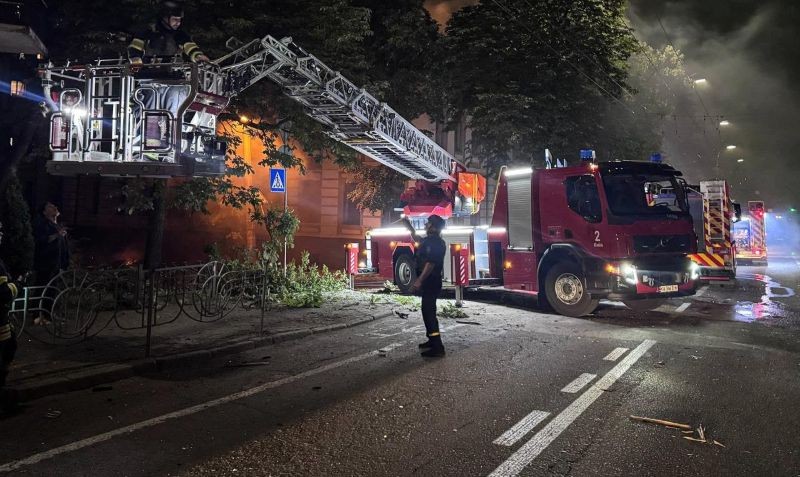
Sharing details of the attack on X, Zelenskyy wrote: "Overnight, Russia carried out one of its largest ballistic missile attacks on Kyiv. The enemy launched more than 40 missiles of various types – most of them against the capital – and 120 attack drones."
Overnight, Russia carried out one of its largest ballistic missile attacks on Kyiv. The enemy launched more than 40 missiles of various types – most of them against the capital – and 120 attack drones.
— Volodymyr Zelenskyy / Володимир Зеленський (@ZelenskyyUa) July 19, 2026
As of now, one person has been reported killed in Kyiv and the region, and 16… pic.twitter.com/YMWDlB6wGA
Expressing condolences to the victim's family, he said emergency teams were continuing rescue operations.
"My condolences to all their families and loved ones. Everyone affected is receiving the necessary medical care. Emergency response efforts are continuing at three locations, with nearly 600 first responders involved. The relevant services are also working in the Odesa region," he said.
The Ukrainian president said Russia had dramatically intensified its aerial campaign over the past week.
"In total, over the course of this week, Russia has used around 1,450 attack drones, more than 1,640 guided aerial bombs, and 99 missiles of various types against Ukraine. People were injured in the Odesa region and Zaporizhzhia, and there was damage in the Sumy and Chernihiv regions. This week, the Vinnytsia, Dnipro, Donetsk, Zhytomyr, Kirovohrad, Mykolaiv, Poltava, Kharkiv, Kherson, and Cherkasy regions also came under Russian attack," Zelenskyy said.
Calling for stronger air defence support, he stressed that protection against ballistic missiles remained Ukraine's top priority.
"Interceptors are needed every day, and I am grateful to everyone who takes our agreements seriously and ensures the delivery of anti-ballistic capabilities. Right now, these packages are literally saving lives during every massive Russian attack. It is also essential that pressure on Russia continue alongside our work on anti-ballistic capabilities. Delays in adopting new decisions give Moscow the opportunity to plan not only new attacks against our people, but also ways to circumvent new sanctions. Thank you to everyone who is helping," he added.
UN report highlights rising civilian toll
The latest strikes came as a new United Nations report warned that civilian casualties in Ukraine surged during the first half of 2026 amid escalating Russian attacks and the increased use of powerful weapons.
According to the report, at least 293 civilians were killed and 1,990 injured in June, making it the deadliest month for civilians since April 2022.
May had already recorded the highest number of civilian casualties in more than four years, with 282 people killed and 1,794 injured, but June surpassed those figures.
During the first six months of 2026, UN monitors verified 1,396 civilians killed and 7,978 injured—a 37 per cent increase compared with the same period in 2025 and a 114 per cent rise over 2024.
Civilian areas under attack
Most civilian casualties occurred in areas under the control of the Ukrainian government, spanning 13 regions and the city of Kyiv. The UN also verified civilian casualties in Russian-occupied territories, although the number was lower than in 2025.
Russia, meanwhile, reported a rise in civilian casualties on its own territory during the first half of the year. According to Russian authorities, 250 civilians were killed and 1,596 injured, representing a 121 per cent increase compared with the same period in 2025.
The UN report also noted that Russia continued targeting Ukraine's energy infrastructure in June, while documenting a sharp increase in Ukrainian strikes on power generation, distribution and transmission facilities in occupied Crimea.
At least 12 attacks on energy infrastructure triggered emergency or scheduled power outages.
Russia launched its full-scale invasion of Ukraine on February 24, 2022. Since then, UN human rights monitors have verified at least 16,431 civilians killed and 48,613 injured, including more than 3,700 children, while noting that the actual toll is likely much higher due to limited access to conflict zones.