
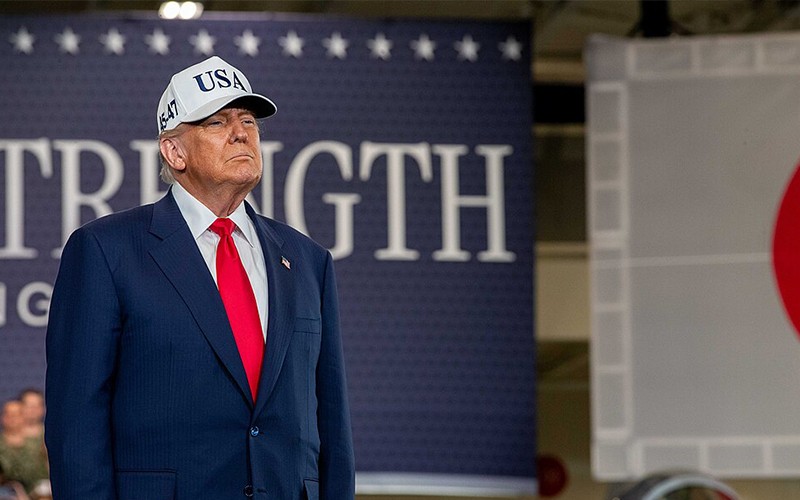
Defending his administration's decision to resume nuke testing, Trump said that several other nations — including Russia, China, North Korea, and Pakistan — are already conducting similar tests.
He argued that it was only “appropriate” for the United States to follow suit.
“Russia’s testing, and China’s testing, but they don’t talk about it. We’re an open society — we talk about it because you people [the media] are going to report,” Trump told CBS News, contrasting the US with more closed systems.
He went on to justify the decision further: “We’re going to test because they test and others test. Certainly, North Korea’s been testing. Pakistan’s been testing.”
Trump also claimed that the US does not “necessarily know” where these nations are carrying out their nuclear experiments, as such tests are often conducted deep underground.
“You feel a little bit of a vibration,” he said, “They test and we don’t test. We have to test.”
His comments came in response to questions about the resumption of nuclear detonations by the US — the first in more than 30 years — following Russia’s recent tests of advanced nuclear-capable systems, including the Poseidon underwater drone.
“You have to see how they work,” Trump explained. “The reason I’m saying testing is because Russia announced they were going to do a test. If you notice, North Korea is testing constantly. Other countries are testing. We’re the only country that doesn’t test — and I don’t want to be the only country that doesn’t test.”
Trump also claimed that the US holds a larger nuclear arsenal than any other nation, adding that he had discussed denuclearisation with both Russian President Vladimir Putin and Chinese President Xi Jinping.
“We have enough nuclear weapons to blow up the world 150 times,” he said. “Russia has a lot, and China will have many more — they already have quite a bit.”
New event, old claim
In the same CBS News interview, the US President claimed that in May, both India and Pakistan were on the brink of a nuclear confrontation, which he said he personally helped avert through his intervention involving trade pressure and tariff threats.
According to him, his actions prevented a catastrophic conflict that could have claimed millions of lives.
“India was ready to go to nuclear war with Pakistan. The Prime Minister of Pakistan stood up… If Donald Trump hadn’t stepped in, millions of people would have died,” Trump said.
“It was a terrible war — planes were being shot down everywhere. I told both of them, if you don’t stop, you won’t be doing any business with the United States,” he added.
Trump further remarked that nations possessing nuclear weapons often conduct tests secretly, away from international scrutiny.
“They don’t tell anyone about it… They test deep underground where people can’t really tell what’s happening. You just feel a slight vibration,” he said.
While global seismic monitoring systems are capable of detecting ground tremors caused by underground nuclear explosions, Trump claimed that such tests could still be carried out covertly, in ways that make them difficult to detect.
Concern for India?
If China and Pakistan are indeed carrying out nuclear weapons tests, the development could make the situation more volatile for India, which adheres to a no-first-use (NFU) policy and has not conducted a nuclear test since 1998.
As of 2025, India’s nuclear arsenal is estimated at around 180 warheads, trailing China’s expanding stockpile of roughly 600—expected to reach 1,000 by 2030—and closely matching Pakistan’s estimated 170 warheads.
Pakistan’s growing fissile material reserves could potentially enable it to field up to 200 nuclear warheads by 2028, including tactical nuclear weapons.
However, it is China’s technological leaps, such as the Fractional Orbital Bombardment System (FOBS) tested in 2021, that pose the more formidable challenge.
FOBS allows warheads to enter partial Earth orbits, bypassing predictable ballistic paths and complicating interception by India’s still-developing Prithvi Defence Vehicle (PDV) system.
Compounding this concern are longstanding doubts about the Pokhran-II tests of 1998, with DRDO scientist K. Santhanam having claimed that India’s thermonuclear device “underperformed,” producing a yield of only 10–15 kilotons instead of the intended 200 kilotons.
Such assertions have continued to cast a shadow over the credibility of India’s thermonuclear capability.
With Donald Trump claiming that the US, along with China and Pakistan, has resumed or continues nuclear testing, some analysts believe this geopolitical shift could open the door for India to consider a potential Pokhran-III series.
Such tests, they argue, could serve to validate India’s hydrogen bomb design and confirm its ability to miniaturise nuclear warheads for advanced delivery platforms like the Agni-VI intercontinental ballistic missile (ICBM) and the K-5 submarine-launched ballistic missile (SLBM).
Nuke tests resumption: America's clarification
US Energy Secretary Chris Wright later clarified that the planned nuclear testing would not involve actual nuclear detonations.
This clarification came after Trump’s earlier social media statement claiming he had instructed the “Department of War” to restart nuclear tests “on an equal basis” with other countries.
Speaking to Fox News, Wright said, “The tests we’re talking about right now are system tests. These are not nuclear explosions — these are what we call non-critical explosions.”
He explained that the upcoming tests would focus on evaluating all non-nuclear components of the weapons systems to ensure they function correctly and achieve the intended geometry and setup necessary for a nuclear explosion.
“These tests are designed to validate new systems and ensure that the next generation of nuclear weapons performs better than the last,” Wright added.