
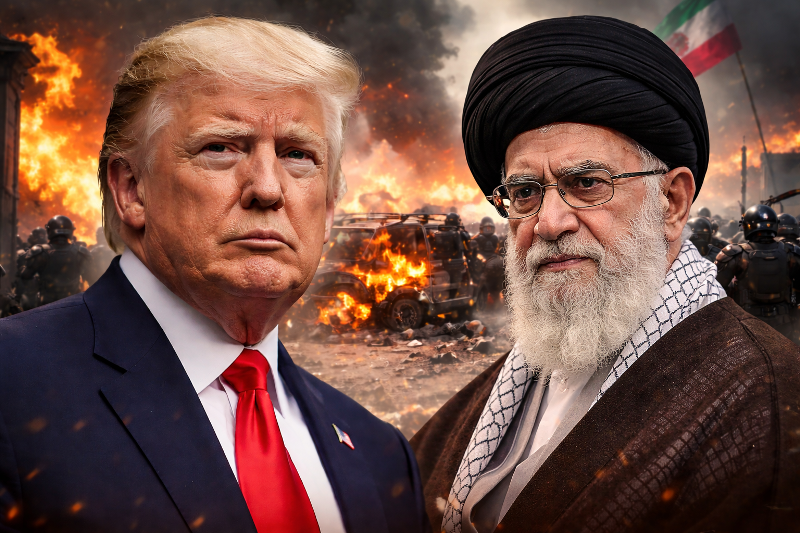
Within 24 hours of unveiling the body — billed as an international organisation to promote stability and lasting peace — Trump was again threatening the use of force against Tehran.
US officials confirmed that a carrier strike group led by the USS Abraham Lincoln, along with guided-missile destroyers and an attack submarine, is being repositioned toward the Arabian Sea or Persian Gulf.
The group, redirected from the South China Sea, is no longer publicly trackable on open-source maritime systems.
The naval deployment is part of a wider US military build-up. F-15E Strike Eagle fighter jets have already arrived in the region, supported by the movement of KC-135 aerial refuelling aircraft to extend strike range.
Additional missile defence systems, including THAAD and Patriot batteries, are reportedly being deployed across allied countries such as Israel and Qatar.
The immediate trigger for the escalation is unrest inside Iran, where nationwide protests over economic hardship have turned violent. Iranian state media has reported more than 3,000 deaths, though rights groups say the toll could be far higher.
Trump has repeatedly accused Tehran of planning mass executions of protesters, claiming US pressure forced Iran to halt hundreds of hangings — assertions Iranian officials deny.
Trump’s rhetoric has fluctuated sharply. After warning that Iran could be “wiped off the face of the earth,” he later softened his tone following indications that executions had been suspended, a pattern analysts describe as coercive pressure combined with tactical de-escalation.
Iran has responded with defiance. President Masoud Pezeshkian accused the US and Israel of fuelling unrest as retaliation for US strikes on Iranian nuclear facilities in June 2025. Tehran has warned it is ready to respond militarily and has issued direct threats against Trump.
Complicating the picture is uncertainty over roughly 400 kilograms of enriched uranium believed to be missing since the June strikes — enough for up to 10 nuclear weapons.
Trump has said the US will strike again if Iran resumes its nuclear programme, while Iran has yet to provide the International Atomic Energy Agency with a full accounting of the affected nuclear material.
Military analysts say any US action would likely begin with limited punitive strikes aimed at warning Tehran while leaving room for diplomacy.
Escalation could follow with attacks on missile, drone, and command infrastructure. Full-scale regime change is widely seen as unlikely due to the risk of a prolonged regional war.
Iran’s likely response would involve calibrated, deniable retaliation through allied groups or pressure on global energy markets. Nearly 20 million barrels of oil pass daily through the Strait of Hormuz, making even limited disruption a powerful lever against Washington.
Israel would inevitably be drawn into any escalation, both as a potential target and as a key element of regional missile defence. While unlikely to seek a wider conflict, its role could prove decisive in containing — or accelerating — a broader confrontation.