
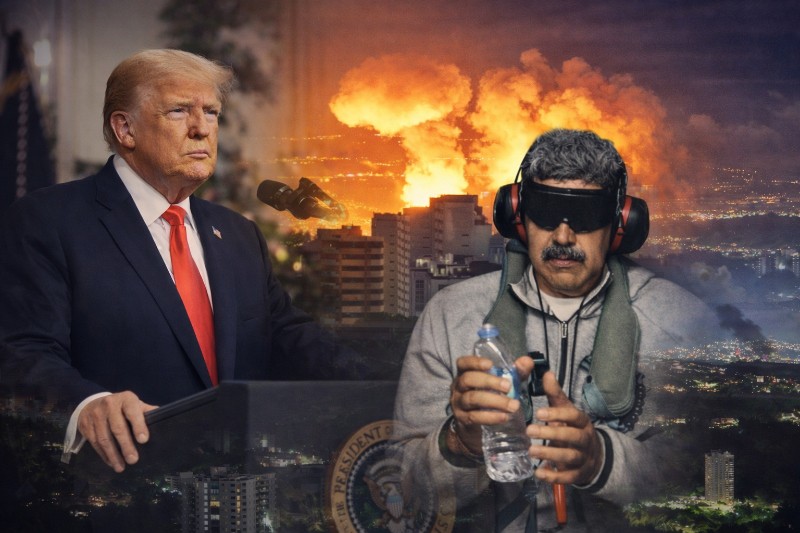
The operation, announced early on Saturday, follows months of military pressure, economic coercion and sharp rhetoric from Washington — but why did Trump take such an extraordinary step, which pushed US–Latin America relations into one of their most volatile phases since the Cold War?
Understanding the alleged capture of Maduro requires tracing a long-running conflict rooted in drugs, migration, ideology and geopolitics.
'Large-scale strike'
Trump said US forces carried out a “large-scale strike” across Venezuela before capturing Maduro and flying him, along with his wife, out of the country to a US military vessel offshore.
He described the mission as a joint operation involving US law enforcement agencies and promised further details at a press conference in Florida.
"At my direction, the U.S. Armed Forces conducted an extraordinary military operation in the capital of Venezuela...This was one of the most stunning, effective, and powerful displays of American military might and competence in American history." - PRESIDENT DONALD J. TRUMP 🇺🇸 pic.twitter.com/QibvrRKsSv
— The White House (@WhiteHouse) January 3, 2026
Before Trump's official confirmation, residents of Caracas reported explosions, low-flying aircraft, power outages near military bases and heavy smoke over parts of the capital.
Venezuela’s government declared a national emergency and accused the United States of attacking civilian and military sites.
America’s longstanding conflict with Venezuela
Venezuela has been at odds with Washington since the late Hugo Chávez rose to power in 1999, positioning the country as a socialist counterweight to US influence in Latin America.
Under Chávez and later Maduro, Caracas aligned itself with US adversaries such as Cuba, Iran and Russia, deepening tensions.
After Chávez’s death in 2013, Maduro inherited an oil-dependent economy that collapsed under mismanagement, corruption and sanctions.
Hyperinflation, shortages and repression triggered one of the largest refugee crises in modern history, with nearly eight million Venezuelans fleeing the country.
Drugs, ‘narco-terrorism’ and US accusations
A central pillar of Trump’s justification is drugs.
The US alleges Venezuela has become a major transit hub for Andean cocaine bound for the United States, Europe and West Africa.
Trump has designated two Venezuelan criminal groups — Tren de Aragua and the Cartel de los Soles — as Foreign Terrorist Organisations.
The administration claims Maduro himself leads or protects cartel networks and deliberately allows drugs to flow north.
Caracas denies the accusations, arguing Washington is weaponising the “war on drugs” to pursue regime change.
While Venezuela has documented links to organised crime, experts say evidence tying Maduro directly to drug operations remains contested.
Migration as a political trigger
Trump has repeatedly linked Venezuela to migration pressure at the US southern border.
Without presenting evidence, he has accused Maduro of forcing criminals and psychiatric patients to migrate to the US — claims Venezuela strongly rejects.
Migration, however, remains a potent political symbol.
Venezuela’s crisis is often cited by Trump officials as proof of the failure of socialism and weak border enforcement, placing the country squarely within the administration’s domestic and foreign policy priorities.
Months of escalating pressure
The strikes followed a sustained military buildup.
The US deployed warships, fighter jets and the aircraft carrier USS Gerald R. Ford to the Caribbean, imposed an oil blockade, seized tankers and conducted dozens of strikes on vessels accused of drug trafficking — operations that reportedly killed more than 100 people.
In December, the US acknowledged a CIA drone strike inside Venezuela.
Trump later said US forces destroyed a docking site allegedly used by drug traffickers — the first confirmed strike on Venezuelan soil during the campaign.
Washington says it is engaged in an “armed conflict” with drug cartels, a legal framing that critics say stretches international law.
Oil, power and regime change claims
Maduro has consistently accused the US of attempting to overthrow him to gain control of Venezuela’s vast oil reserves — the largest in the world.
Notably, days before the strikes, Caracas said it had offered cooperation on migration and drug enforcement, suggesting talks collapsed shortly before the military operation.
During Trump’s first presidency, the US pursued covert and overt pressure to remove Maduro.
After returning to office in 2025, Trump initially explored limited engagement before abruptly reversing course — a shift widely attributed to hardliners like Secretary of State Marco Rubio.
What's next
US President Donald Trump made a dramatic assertion that Washington would effectively take control of Venezuela until what he described as a “safe, proper and judicious” political transition is completed.
"Maduro and his wife will soon face the full might of American justice and stand trial on American soil." - President Donald J. Trump 🇺🇸 pic.twitter.com/aFag9QOkpH
— The White House (@WhiteHouse) January 3, 2026
Speaking at a press conference from his Florida residence, Trump made the remarks just hours after US special forces launched an unprecedented operation in the oil-rich South American nation, allegedly capturing President Nicolas Maduro and his wife, Cilia Flores.
“We’re going to run the country until the time comes for a secure and orderly transition,” Trump said. “We don’t want to install someone else and end up with the same situation that’s existed for years. So for now, we’re going to run the country.”
Trump did not provide any timeline, legal basis or governance framework for how such an extraordinary arrangement would function under US or international law.
“We’re going to be running it with a group. We’re designating people,” Trump added, without offering further details.
The US president openly acknowledged that regime change and access to Venezuela’s vast oil reserves were central objectives of the operation.
“We’re going to bring in our major United States oil companies — the biggest anywhere in the world — to invest billions, repair the severely damaged infrastructure, and sell large volumes of oil,” he said.
Trump also made it clear that Washington was prepared to deploy ground forces if necessary, saying the United States was “not afraid of boots on the ground.”