
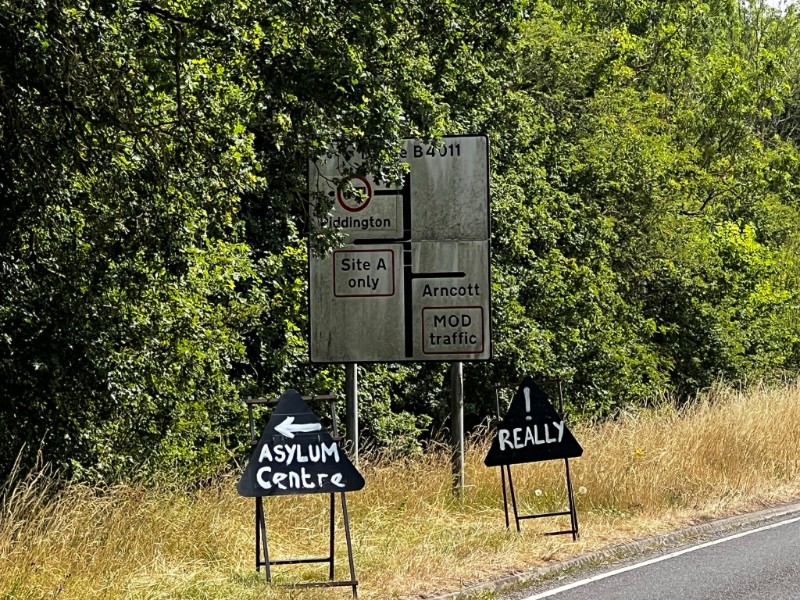
Piddington, a village of around 350 people near Bicester and about 25 kilometres from Oxford, held the unofficial vote on Tuesday after the Government announced plans to house up to 1,256 single adult male asylum seekers at a former Ministry of Defence facility.
Of the 312 ballots counted, 285 residents voted in favour of the village seeking to leave the UK and pursue self-determination. Twenty-six voted against, while one ballot was spoiled.
The turnout was nearly 92 percent.
🇬🇧 "This is ONLY the start"
— VoxPopuli (@vpopulimedia) September 16, 2026
Chair of Piddington Parish Council, @PiddingtonRoars, gives a speech after they voted 91% for LEAVING the UNITED KINGDOM. https://t.co/EOMvdH6RJz pic.twitter.com/4J1eJ0y7IJ
The referendum has no legal or constitutional effect, but parish councillors said it was intended to draw attention to residents’ concerns over the scale of the proposed asylum centre and what they regard as insufficient local consultation.
‘Principality of Piddington’
The ballot asked residents whether they supported “Piddington seeking to secede from the United Kingdom and pursuing self-determination”.
Following the result, parish council chair Tim McNally said the village would now be known as the “principality of Piddington”.
McNally told Sky News that the central concern was the scale of the proposed accommodation compared with the size of the existing community.
“For us, it's about proportionality — how does a small village of 350 odd people assimilate with 1,250 males?” he said.
He also accused the Government of “trying to rush this whole plan through”.
The symbolic referendum was organised by Piddington Parish Council after residents had previously backed the idea of holding an unofficial independence vote.
The result was announced on Wednesday morning in front of residents and journalists gathered outside the village hall.
Concerns over asylum centre
The proposed facility is at a former military site near Piddington and is expected to accommodate 1,256 male asylum seekers.
The Government has said the former military facility is part of its wider effort to reduce reliance on hotels for asylum accommodation.
Police in Piddington are telling the women there to “take precautions” to prepare for the massive influx of illegal migrant men.
— I Am British 🇬🇧 (@IAmBritishReal) September 16, 2026
This is a disgrace! pic.twitter.com/qLJJCixmtZ
The Labour government, which came to power in July 2024, has pledged to end the use of asylum hotels by the end of the current Parliament in 2029.
Culture Secretary Lisa Nandy defended the use of former military sites, telling the BBC that the Government needed to provide accommodation while addressing the asylum system.
“We do have to house people somewhere while we get a grip on the asylum chaos and that base will go ahead,” she said.
Nandy has also argued that former military facilities provide a more suitable alternative to hotels and rented accommodation for housing asylum seekers.
The Government has said the site would house single adult male asylum seekers for a minimum of 10 years. It has also stated that the “safety and security” of asylum seekers, staff working at the facility and the surrounding community would be “of the utmost importance”.
Village leaders raise proportionality
Tim Bearder, leader of Oxfordshire County Council, said the referendum highlighted the strength of local concerns about the proposed centre.
“I think what this result shows is that Piddington campaigners have done an incredible job to highlight their concerns about the proposed asylum centre,” Bearder told the BBC.
He also warned that the planned facility could attract far-right demonstrations to the area.
The county council leader said the centre “will be a lightning rod to the far right, who come here to protest” and could potentially lead to attacks on asylum seekers.
Pittington Votes to Secede: A Battle for Democracy
— Tim McNally (@PiddingtonRoars) September 15, 2026
Why is Piddington voting on secession on 15 September?
Because a proposed ten-year development beside our village has brought repeated questions—and too few answers. We’ve asked the Home Office, MPs and Andy Burnham to listen.… pic.twitter.com/pMA1CfAZZ3
The Government has maintained that the accommodation plan forms part of a broader national approach in which communities across Britain are expected to contribute to housing asylum seekers.
The proposal has also become part of a wider national debate over the Government’s plans to move away from hotel-based asylum accommodation and towards the use of former military facilities.
Residents voice their fears
The referendum campaign has brought individual residents’ concerns into national focus.
Herbert Owen, a 76-year-old Piddington resident, told AFP that he had voted to leave the UK because he felt the Government did not “care” about the village.
“We have a village hall, a 12th-century church and a playing field — and that's it,” resident Ian Darby, 63, said while questioning how asylum seekers housed at the facility would spend their time.
“It is a takeover of our village; it's four times the people of this village. They are going to want to get out and get about locally, and that raises serious issues,” Darby said.
Seventeen-year-old student and part-time stablehand Dita Jackson also expressed concerns about how the proposed centre could affect everyday life in the village.
“I've lived here my whole life. I won't really feel safe enough to walk around anymore,” she told AFP.
The concerns expressed by residents have centred on the scale of the proposed accommodation, its proximity to the village and the potential impact on local life.
Referendum inspired by British comedy
The unusual independence vote was partly inspired by the 1949 British comedy film Passport to Pimlico.
In the film, residents of a London neighbourhood discover a buried treasure and subsequently declare their area independent, allowing them to escape restrictions imposed in post-war Britain.
The people of Piddington have voted to leave the UK after the Home Office announced plans to dump 1,250 illegal migrant men in their community.
— Nick Marcel Tenconi (@NickTenconi) September 16, 2026
Of a population of 358, 285 voted to leave whilst only 26 voted to remain.
This shows the power of communities rallying together to… pic.twitter.com/BKgod0ZUmf
Piddington's referendum similarly used the idea of declaring independence as a symbolic protest rather than as a legally binding constitutional process.
The village's parish council has described the move as a way of giving residents a platform to express their opposition to the Government's asylum accommodation plans.
The campaign has also adopted the language of independence, with references to the “Principality of Piddington” appearing around the village during the referendum.
Part of wider UK asylum debate
The Piddington vote comes amid continuing protests in parts of Britain over plans to accommodate asylum seekers in hotels, former military sites and other facilities.
The Labour government is seeking to phase out hotel accommodation, a policy it inherited from the previous Conservative administration.
It has instead been looking to former military bases and other large sites as alternatives.
🚨NEW: Women in Piddington, a village of just 350 people where the government plans to put 1,250-3,500 illegal migrants, have released a video begging female MPs to speak out for them in Parliament pic.twitter.com/IG2jiPNbyG
— GB Politics (@GBPolitcs) September 10, 2026
The Government's approach has generated opposition in several communities, with local campaigners raising questions about consultation, the scale of proposed accommodation and the impact on surrounding areas.
In Piddington, those concerns culminated in an unusual symbolic referendum, with residents voting overwhelmingly in favour of the village pursuing “self-determination”.