
The effect is already visible in the US labour market. During the first few months of 2026, the technology and finance sectors shed an average of 28,000 jobs every month, even as overall employment continued to grow.
Also Read: From AI to killer robots: UN chief Antonio Guterres issues chilling global warning
According to US government employment data analysed by Bloomberg and cited by Yahoo Finance, payrolls in the financial activities and information sectors declined by an average of 28,000 jobs a month in 2026.
Forward Deployed Engineer (FDE) is the hottest job role in 2026.
— Gaurav Sen (@gkcs_) July 6, 2026
But what does an FDE do?
They help companies build production-grade AI applications. Companies want to integrate AI into their products.
The pattern surfaced in a review of government payroll data published recently. Separately, Challenger, Gray, and Christmas tracked 45,849 U.S. job cuts in June, the lowest monthly total since December 2025. Technology still led every sector, announcing 15,503 cuts for a year-to-date total of 139,156, up 83% from 2025, the news portal reported.
According to reports, AI has driven 101,743 layoffs so far this year, about 23% of all cuts the firm tracked.
AI is eliminating jobs—but also creating new ones
While AI is increasingly being viewed as a major force behind job displacement, it is also giving rise to entirely new career paths.
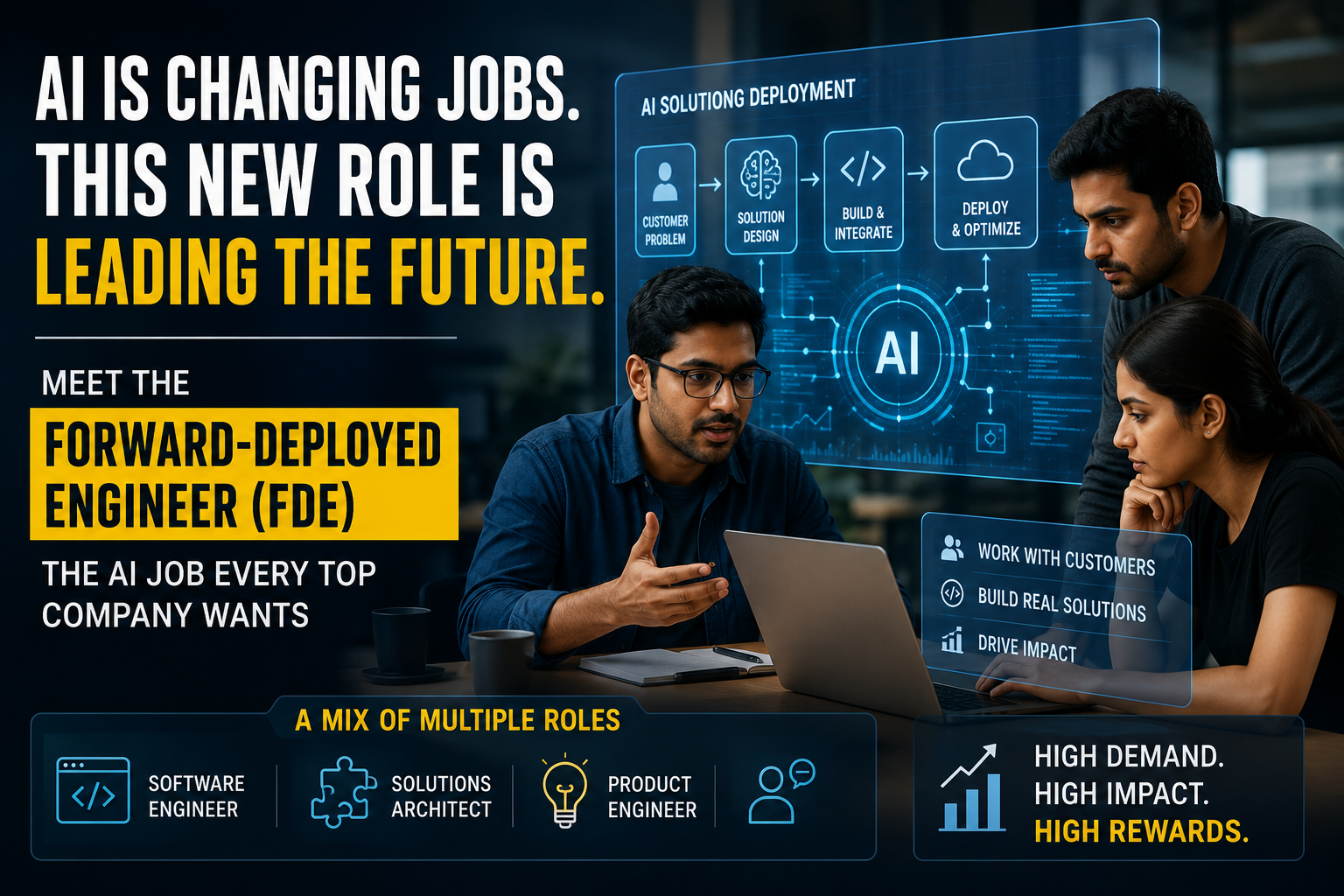
One of the fastest-growing roles in enterprise AI is that of a Forward-Deployed Engineer (FDE).
What is a Forward-Deployed Engineer (FDE)?
According to Future Ventures, the Forward-Deployed Engineering (FDE) model has emerged as an effective way for startups and AI companies to bridge the gap between product development and customer needs.
Rather than working solely on internal product development, FDEs work directly with enterprise customers, helping them deploy AI solutions tailored to their specific business challenges.
The role was popularised by Palantir Technologies and has since been adopted by leading AI companies including OpenAI, Anthropic, Scale AI, Databricks, and Snowflake.
Industry experts say the position barely existed a year ago but has quickly become one of the most sought-after jobs in AI as businesses race to integrate artificial intelligence into their daily operations.
According to Moneycontrol, staffing firms estimate there are only 500 to 800 FDE openings worldwide, with around 230 positions currently available in India.
Broadly speaking, an FDE combines the responsibilities of a:
Software Engineer
Solutions Architect
Product Engineer
Technical Consultant
What does an FDE do?
A Forward-Deployed Engineer typically:
Works directly with enterprise customers
Understands business challenges and translates them into technical solutions
Builds custom integrations using APIs
Writes production-grade software
Deploys AI systems into customer environments
Collaborates with product managers and engineering teams
Troubleshoots complex technical issues
Travels to customer sites when required or works closely with them remotely
Skills companies look for
Most employers expect FDEs to have expertise in:
Python, Java, Go, C++, or TypeScript
AWS, Azure, or Google Cloud Platform
APIs and microservices
SQL and databases
Kubernetes and Docker
AI and machine learning deployment
Strong communication and customer-facing skills
Ability to explain technical concepts to non-technical stakeholders
Why are companies hiring FDEs?
Unlike traditional software engineers, FDEs don't expect customers to adapt to the product. Instead, they adapt the product to meet customer requirements.
This approach enables companies to:
Deploy enterprise AI faster
Improve customer satisfaction
Gather better product feedback
Increase customer retention and revenue
The role has become especially important as businesses seek customised AI deployments rather than one-size-fits-all solutions.
Experts explain why the role is different
Prajwal Waykos, a Forward-Deployed Engineer at Australian AI firm tRetail Labs, said customers often begin with what appears to be a simple request, but the real challenge lies in discovering the underlying business problem.
"It's not a role where you disappear for two weeks and come back with a finished product," the 24-year-old IIT graduate told Moneycontrol. "You're building with the customer, not just for the customer."
An FDE at a frontier AI company, speaking anonymously because they were not authorised to comment publicly, said the biggest misconception is that FDEs are simply consultants who can code.
"In reality, we're responsible for making sure AI actually works inside a customer's business. That means understanding their operations, writing production code, debugging models, working with researchers, and staying with the customer until the system delivers value," the engineer said.
Poojitha Rachuri, an FDE at healthcare AI startup Confido, described the role as a blend of engineering and business analysis.
Before writing a single line of code, she first focuses on understanding the customer's actual problem.
"Many customers describe the solution they want," Rachuri, who trained at FDE Academy of Futurense Technologies, told Moneycontrol. "Our job is to figure out the problem they're actually facing."
'India can be the FDE factory for the world.'
— CNBC-TV18 (@CNBCTV18News) July 3, 2026
What is a Forward Deployed Engineer (FDE) and why is it becoming AI's hottest new job?
Speaking to Shereen Bhan on Young Turks Reloaded, Fundamentum Co-founder Sanjeev Aggarwal says FDEs combine the skills of an engineer, product… pic.twitter.com/VYA8JUV0ln
Meanwhile, Fundamentum co-founder Sanjeev Aggarwal believes Forward-Deployed Engineers represent the future of enterprise AI.
In a recent interview with CNBC, Aggarwal said FDEs combine the expertise of a software engineer, product manager, and AI architect to solve real-world business problems.
"It's almost like a unicorn... a 10x engineer," he said.
According to Aggarwal, a company could potentially build a $100 million business with just 100 FDEs, compared with requiring 2,000–2,500 employees under a traditional IT services model.
"The gross margins can be as high as 70–80–90%," he added.