
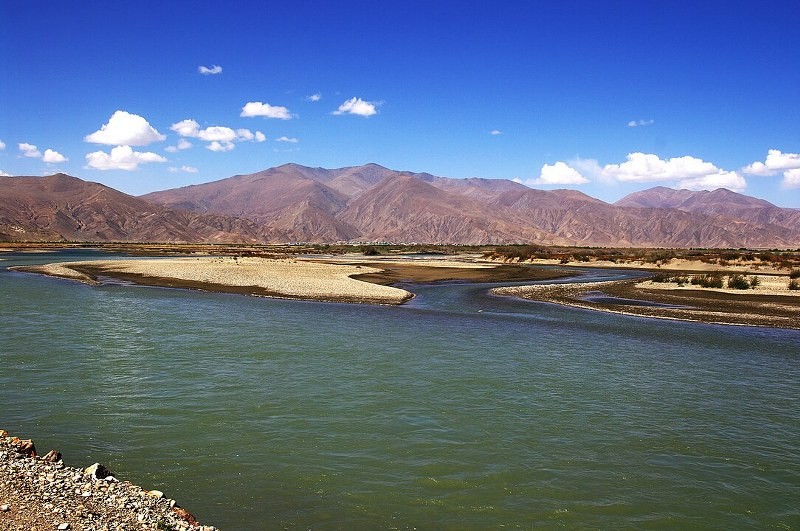
Stated to be the world’s biggest infrastructure project, the dam will be built in the lower reaches of the Yarlung Zangbo River, the Tibetan name for Brahmaputra.
The announcement about the dam's construction was made in an official statement quoted by state-run Xinhua news agency on Wednesday (Dec 25).
The cost of construction is likely to surpass one trillion yuan ($137 billion).
According to experts, downstream India and Bangladesh should be worried about possible ecological harm and water disruptions in future.
The mammoth size of the project would overshadow any other single infrastructure project in any country, including China's own Three Gorges Dam, considered the largest in the world, the Hong Kong-based South China Morning Post reported Thursday.
The announcement about the dam on the Brahmaputra River near the Indian border was made on the occasion of the 131st birth anniversary (December 26) of Mao Zedong, hailed as the 'Father of Modern China' for his role in leading the Red Army during the Chinese Civil War.
On the same occasion, China also unveiled videos of its purported sixth-generation stealth fighter jet, in a bid to exhibit its leap in military strength.
Geopolitical impact
India has not released an official reaction to China’s announcement on the dam.
However, it is natural for India to monitor all developments on the Brahmaputra, as it can lead to serious water security concerns for the country.
The Brahmaputra is a lifeline for millions in northeastern India, and China's unilateral control over its waters could provide it with a strategic advantage during conflicts.
The 60,000 MW Motuo mega dam on the Yarlung Tsangpo, called the Brahmaputra in India, raises concerns over environmental and seismic risks as it is planned in an ecologically sensitive area.
China has previously assured India that it focuses only on run-of-the-river projects along the river.
Notably, Beijing's announcement came just a week after Special Representative-level discussions between India’s National Security Advisor Ajit Doval and Chinese Foreign Minister Wang Yi, where data-sharing on transboundary rivers was a key topic.
A China observer cited by India Today remarked, “The construction of the dam is likely to heighten tensions between India and China, particularly regarding water security. India has already expressed concerns about China's control over upstream water resources.”
Geological and ecological challenges
The proposed dam site is located in a massive gorge in the Himalayan region where the Brahmaputra takes a sharp U-turn to flow into Arunachal Pradesh and eventually Bangladesh.
Positioned in one of the world's deepest canyons, just after this bend, the site lies between Namcha Barwa and Gyala Peri, the two tallest peaks of the eastern Himalayas. The elevation here drops sharply by over 2,000 metres.
To divert half of the river's flow, the project will require drilling four to six 20-km-long tunnels through Namcha Barwa.
The site is situated on a tectonic plate boundary prone to earthquakes.
The Tibetan plateau, often referred to as the roof of the world, is seismically active due to its position over tectonic plates.
An observer warned that the dam could substantially alter the river's flow, impacting aquatic ecosystems, according to the India Today report.
Species dependent on specific flow patterns may face extinction or population declines.
Additionally, the dam may trap sediments essential for sustaining downstream habitats, potentially causing erosion and the loss of fertile lands in India and Bangladesh.
The observer further noted that changes to water flow could endanger various species, including endemic fish and wildlife, in the ecologically rich Brahmaputra basin.
While the dam might aid in controlling upstream floods, it could pose a risk of sudden or large water releases, causing unexpected downstream flooding and threatening over 400 plant and fish species.
Large dam projects typically involve extensive land acquisition, resulting in significant displacement and economic challenges for local communities. Climate change adds another layer of concern, with global warming accelerating glacier melt.
This could trigger extreme water flow and flooding in India’s northeastern states and Bangladesh.
Another observer highlighted that shifts in water availability could adversely affect agricultural productivity in both countries, where irrigation heavily depends on consistent river flows.