
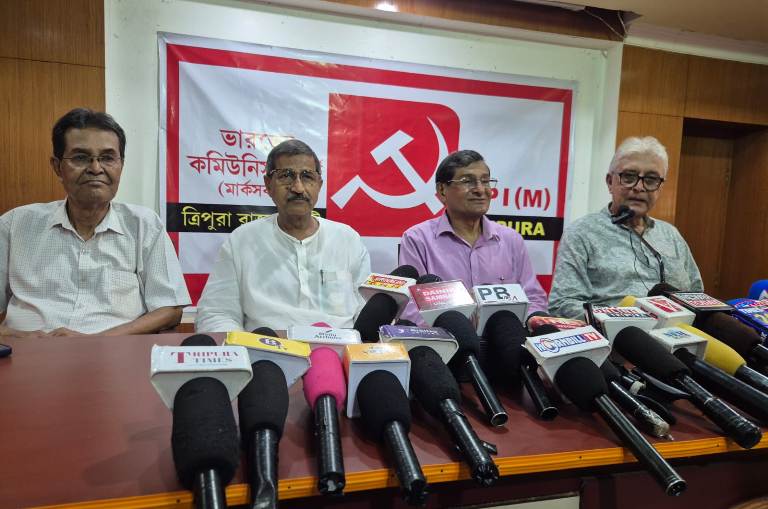
Raising questions over the state’s electricity management, additional charges on consumers and the ongoing installation of smart meters, former Power Minister Manik Dey raised questions over electricity smart meter policy of the state government.
Addressing a press conference at CPI (M) state headquarters in Agartala on Saturday afternoon, former Power Minister Manik Dey, former Finance Minister Bhanulal Saha, Tripura Electricity Consumers and Employees Welfare Association Secretary Natraj Dutta and former MP Sankar Prasad Datta said that Tripura’s electricity system was once directly managed by the state government.
Speaking at the press conference, Manik Dey said that the Tripura State Electricity Corporation Limited (TSECL) was subsequently formed in 2004, and from January 1, 2005, responsibility for power generation, transmission and distribution was handed over to the corporation.
He said that the power generation system was later separated as well. However, Tripura’s own power generation capacity has now fallen short of the state’s requirements, forcing it to purchase a substantial amount of electricity from outside sources, including central generating agencies.
According to Dey, the rising cost of power procurement could eventually affect the financial balance of the electricity sector and place an additional burden on consumers.
He argued that greater emphasis should be placed on increasing the efficiency and output of Tripura’s own power generation capacity and reducing dependence on relatively expensive power purchased from outside the state.
Dey also questioned the additional charges imposed on consumers for the use of natural gas in power generation.
He claimed that the gas used for power generation at projects such as Palatana and Baramura, Rukhia is natural gas produced in Tripura and is not imported gas. Therefore, he questioned the justification for imposing an additional financial burden on consumers on the grounds of rising international gas prices or the cost of imported gas.
He further said that the state government receives royalty from Tripura’s natural gas and could use a portion of the royalty to reduce the burden on consumers.
According to Dey, additional duties or charges on gas consumption have been imposed since the 2019-20 financial year. He claimed that additional charges are being collected on specified levels of residential consumption, while commercial and industrial consumers are being charged up to 7.5 per cent of their electricity bills.
He questioned why consumers should bear an additional financial burden when the gas is produced in Tripura and the state government already receives royalty from it.
Dey also questioned the government’s current policy of installing smart electricity meters. He recalled that, during an earlier initiative aimed at improving the power system under pressure from the World Bank, around 50,000 meters were installed experimentally in Agartala city. At that time, he said, there were no widespread complaints about unusually high meter readings or increased electricity bills.
According to Dey, one of the reasons was that those meters had been installed through government-controlled agencies. Therefore, if there was any problem with a meter, the government and the concerned public agency were responsible for addressing it, including replacement or rectification.
However, he said the current smart meter installation process was different, as the meters are being installed through private companies.
“This raises a major question about who will be responsible if a smart meter develops a problem in the future—the government or the private company concerned,” Dey said.
He also compared the cost of smart meters with that of conventional meters. According to him, a smart meter costs approximately Rs 8,000–10,000, while the earlier meters cost around Rs 1,400–1,600.
He questioned who would bear the additional cost if a smart meter needed to be replaced in the future.
Dey said he had expected the government to issue a clear statement on the smart meter policy, particularly as opposition and public dissatisfaction over smart meters have been reported in different parts of the country.
He also claimed that several states have so far been unable to implement smart meter installation on a large scale.