
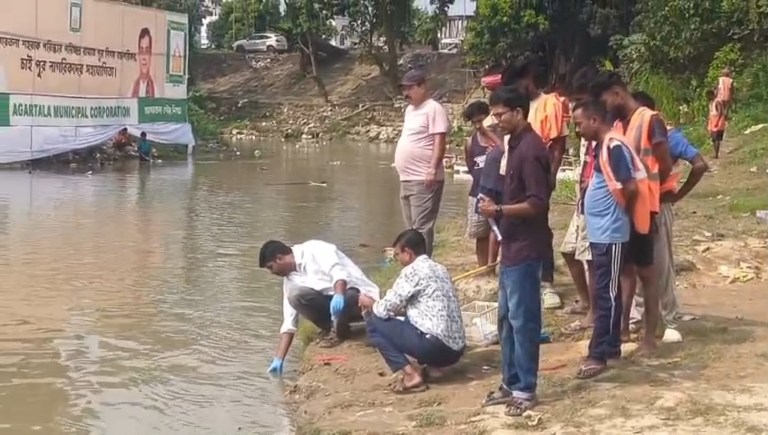
The Tripura State Pollution Control Board has initiated a post-Durga Puja assessment to determine the extent of water pollution in the Howrah River following the completion of idol immersion rituals. Alongside collecting river water samples for laboratory testing, the board is also monitoring air and noise pollution levels to compare environmental conditions before and after the festivities.
On Saturday, a four-member team of the Tripura State Pollution Control Board (TSPCB) visited Dashamighat in Agartala and collected water samples from the Howrah River. The samples have been sent to the board’s laboratory for analysis.
The team comprised Gautam Ghosh, Dr Rajib Paul, Ratan Debnath and Project Officer Prasenjit Das.
Speaking about the sampling exercise, Dr Rajib Paul, an official of the TSPCB, said the monitoring was being conducted as part of the annual environmental assessment in accordance with the guidelines of the Central Pollution Control Board.
He explained that water samples had been collected and tested before Durga Puja, and fresh samples were now being collected after the immersion rituals to assess changes in water quality and establish a comparative picture of pollution levels before and after the festival.
The sampling and testing process will continue for the next five to six days, Dr Pal said. Following an analysis of the findings, a comparative report will be prepared and forwarded to the relevant departments of both the state and central governments.
Apart from monitoring water quality, the board has also been assessing air and noise pollution. According to Dr Pal, monitoring of air and noise pollution began during Ganesh Puja, and reports based on the collected data are being submitted to the concerned departments.
The monitoring exercise is not limited to Agartala. River water quality, air pollution and noise levels are also being assessed in various parts of the state, including Kumarghat and Udaipur.
Through this continued environmental surveillance, the Tripura State Pollution Control Board aims to evaluate the impact of pollution during the festive season and provide authorities with data to assess changes in environmental quality.