
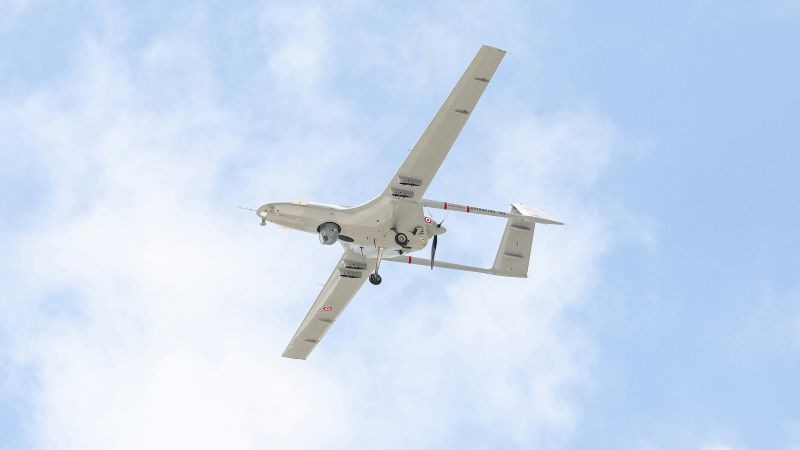
“There is no place for lethal autonomous weapon systems in our world,” Guterres said on Monday, during an informal UN meeting in New York focused on the use and impact of such weapons.
“Machines that have the power and discretion to take human lives without human control should be prohibited by international law.”
The two-day meeting in New York brought together Member States, academic experts and civil society representatives to examine the humanitarian and human rights risks posed by these systems.
The goal: to lay the groundwork for a legally binding agreement to regulate and ban their use.
Human control is vital
While there is no internationally accepted definition of autonomous weapon systems, they broadly refer to weapons such as advanced drones which select targets and apply force without human instruction.
The Secretary-General said in his message to the meeting that any regulations and prohibitions must make people accountable.
“Human control over the use of force is essential,” Guterres said. “We cannot delegate life-or-death decisions to machines.”
There are substantial concerns that autonomous weapon systems violate international humanitarian and human rights laws by removing human judgement from warfare.
The UN chief has called for Member States to set clear regulations and prohibitions on such systems by 2026.
Approaching a legally binding agreement
UN Member States have considered regulations for autonomous weapons systems since 2014 under the Convention on Certain Conventional Weapons (CCW) which deals with weapons that may violate humanitarian law.
Most recently, the Pact for the Future, adopted in September last year, included a call to avoid the weaponization and misuse of constantly evolving weapons technologies.
Stop Killer Robots – a coalition of approximately 270 civil society organizations – was one of the organizations speaking out during this week’s meeting.
Executive Director Nicole van Rooijen told UN News that consensus was beginning to emerge around a few key issues, something which she said was a “huge improvement.”
Specifically, there is consensus on what is known as a “two-tiered” approach, meaning that there should be both prohibitions on certain types of autonomous weapon systems and regulations on others.
However, there are still other sticking points. For example, it remains unclear what precisely characterizes an autonomous weapon system and what it would look like to legislate “meaningful human control.”
Talks so far have been consultations only and “we are not yet negotiating,” Ms. Rooijen told UN News: “That is a problem.”
‘Time is running out’
The Secretary-General has repeatedly called for a ban on autonomous weapon systems, saying that the fate of humanity cannot be left to a “black box.”
Recently, however, there has been increased urgency around this issue, in part due to the quickly evolving nature of artificial intelligence, algorithms and, therefore, autonomous systems overall.
“The cost of our inaction will be greater the longer we wait,” Rooijen told us.
Rooijen also noted that systems are becoming less expensive to develop, something which raises concerns about proliferation among both State and non-state actors.
The Secretary-General, in his comments Monday also underlined the “need for urgency” in establishing regulations around autonomous weapon systems.
“Time is running out to take preventative action,” Guterres said.