
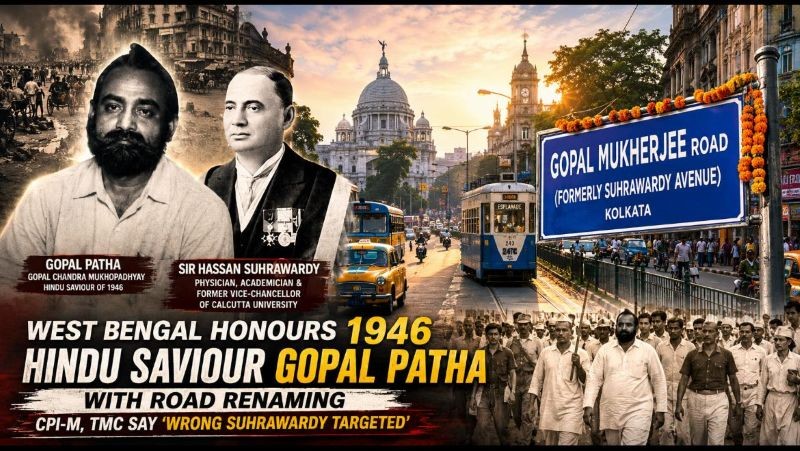
However, the decision has sparked a political controversy, with opposition parties, including the Trinamool Congress (TMC) and the CPI(M), arguing that the avenue was named after Sir Hassan Suhrawardy, a distinguished physician, academician and former Vice-Chancellor of Calcutta University, and not after Huseyn Shaheed Suhrawardy, the politician often associated with the Direct Action Day violence of 1946.
CM appreciates KMC's decision
In a post on X, Adhikari welcomed the move, stating: “I commend the historic decision taken by the Kolkata Municipal Corporation on the solemn occasion of Paschimbanga Divas, which will be instrumental in rectifying a historical wrong. Suhrawardy Avenue will now be renamed as Gopal Mukherjee Road.”
I commend the historic decision taken by the Kolkata Municipal Corporation, yesterday, on the solemn occasion of Paschimbanga Divas, which would be instrumental in rectifying a historical wrong.
— Suvendu Adhikari (@SuvenduWB) June 21, 2026
Suhrawardy Avenue will now be renamed as Gopal Mukherjee Road.
For decades, a major… pic.twitter.com/eUmZj1msE9
He alleged that the road had been named after Huseyn Shaheed Suhrawardy, whom he accused of misusing state power and being linked to the communal violence that engulfed Calcutta during Direct Action Day in 1946.
Praising Gopal Mukherjee, popularly known as Gopal Patha, Adhikari said: “By renaming it after Shri Gopal Mukherjee, the fearless soul who stepped forward to defend and save thousands of innocent lives, historical justice will finally be restored by honouring a true guardian and protector. It is time West Bengal remembers, corrects and honours its real heroes.”
Huseyn Shaheed Suhrawardy was the last Premier of undivided Bengal and remains a controversial historical figure. Many historians have accused him of playing a significant role in the communal violence that erupted during Direct Action Day in Calcutta in August 1946.
Opposition leaders voice objection
However, TMC leaders were quick to challenge the rationale behind the renaming.
Former Rajya Sabha MP and TMC national spokesperson Saket Gokhale wrote on X: “Suhrawardy Avenue in Kolkata was named after Hassan Suhrawardy — an academic, physician and the first Muslim Vice-Chancellor of Calcutta University. The road was named in his honour in April 1933. It was not named after Huseyn Shaheed Suhrawardy, who is often referred to as the ‘Butcher of Bengal’.”
This is what happens when absolute fools take control of the govt.
— Saket Gokhale (@SaketGokhale) June 21, 2026
Suhrawardy Avenue in Kolkata was named after Hassan Suhrawardy - an academic and art critic who also became the first Muslim Vice-Chancellor of Calcutta University. The road was named in his honor in April 1933.… https://t.co/3YUYzYcHfn
TMC MLA Kunal Ghosh echoed the concern, saying the Kolkata Municipal Corporation may have acted on a mistaken understanding of history.
“I think KMC has made a serious mistake. The road was named in memory of Sir Hassan Suhrawardy, a prominent physician, educationist and former Vice-Chancellor of Calcutta University. He also served as Chief Medical Officer of the East Indian Railway and was a member of the Bengal Legislative Council,” Ghosh said.
.@SuvenduWB
— Kunal Ghosh (@KunalGhoshAgain) June 21, 2026
I think KMC has done a great mistake.
The related road is named after/ in memory of Dr SIR HASSAN SUHRAWARDY, Former Vice Chancellor of Calcutta University, an prominent physician and educationist. He was Chief Medical Officer of East Indian Railway. He joined… https://t.co/wPZGHYO30j pic.twitter.com/tQF33ozd9v
He pointed out that Huseyn Shaheed Suhrawardy, who was the administrative head of Bengal during the Calcutta killings, was Sir Hassan Suhrawardy’s nephew and that the two should not be confused.
“The Chief Minister should verify the facts and instruct KMC to examine the records. If, by mistake, the uncle is being punished for the actions attributed to his nephew, it would be unfortunate,” he added.
The CPI(M) also criticised the decision, describing it as being based on a “blatant historical falsehood”.
In a statement posted on Facebook, the party said: “We express deep resentment and strong protest against the Kolkata Municipal Corporation’s decision to rename Suhrawardy Avenue as Gopal Mukherjee Road, and against the statements made by the Chief Minister and the Higher Education Minister in support of the move.”
The party further argued that the controversy stems from a misunderstanding regarding the identity of the person after whom the road was originally named.
Who was Hassan Suhrawardy?
Sir Hassan Suhrawardy was a renowned Bengali surgeon, military officer, politician and public servant. He became the first Muslim Vice-Chancellor of Calcutta University, serving from 1930 to 1934, and was the second Muslim from the Indian subcontinent to be elected a Fellow of the Royal College of Surgeons of England.
In 1945, he was appointed Professor of Islamic History and Culture at Calcutta University while continuing as Professor of Public Health and Hygiene, a position he had held since 1931.
He also served as an adviser to the Simon Commission and was a member of the Bengal Legislative Council, where he held the post of Deputy President between 1923 and 1925. As Chief Medical and Health Officer of the East Indian Railway, he established the railway’s ambulance and nursing services.
Who was Gopal Patha?
Gopal Chandra Mukhopadhyay, popularly known as Gopal Patha, was a businessman from Kolkata who gained prominence during the communal violence of 1946. He organised an armed group known as the Bharatiya Jatiya Bahini, which he said was formed to protect Hindus during the riots.
He earned the nickname “Gopal Patha” because of his family’s meat business, which included a mutton shop in Kolkata. Supporters regard him as a defender of the Hindu community during a turbulent period in Bengal’s history, while his role remains a subject of historical and political debate.
What is Direct Action Day?
The Direct Action Day, which occurred on August 16, 1946, was the day the All-India Muslim League decided to take a "direct action" using general strikes and economic shutdown to demand a separate Muslim homeland after the British exit from India.
Also known as the 1946 Calcutta Riots and Great Calcutta Killings, it soon became a day of communal violence in Calcutta. It led to large-scale violence between Muslims and Hindus in the city of Calcutta in the Bengal province of British India.