
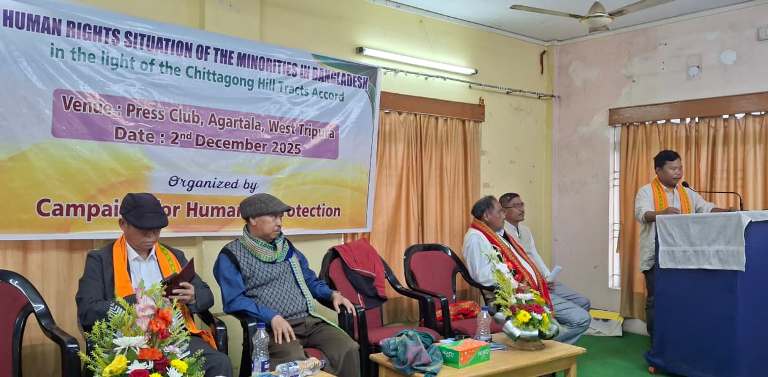
On the 28th anniversary of the signing of the historic 1997 Chittagong Hill Tracts (CHT) Peace Accord, Chakma intellectuals and rights activists on Tuesday issued a strong warning to India, urging New Delhi to adopt a far more proactive stance as radicalization in Bangladesh intensifies and the CHT situation deteriorates sharply.
The concerns surfaced during a discussion titled “Human Rights Situation of the Minorities in Bangladesh in the light of the Chittagong Hill Tracts Accord”, organized at the Agartala Press Club by Campaign for Humanity Protection.
Speakers noted that since the collapse of the Sheikh Hasina government after the August 2024 student-led uprising and the emergence of the interim regime under Chief Adviser Muhammad Yunus, Bangladesh has experienced a surge in radical Islamist influence.
Combined with the near-total non-implementation of the CHT Peace Accord, the region has entered a phase of alarming volatility—one that experts say poses a direct national security threat to India.
Dr Shyamal Bikash Chakma, Research Officer at Tata Institute of Social Sciences, Mumbai, cautioned that India can no longer afford a passive approach.
“The threat today is far greater than in previous decades. If indigenous people lose their land and are outnumbered due to radical Islamisation, the impact will spill into India through refugee influx and border instability,” he said.
Dr Chakma argued that India’s present geopolitical priorities appear to have sidelined the CHT from strategic consideration.
“If the Accord continues to remain unimplemented, India must recognize that this is not merely Bangladesh’s internal issue. It has direct implications for our national security,” he stressed.
Dr Chakma observed that while India was once serious about developments in the CHT, that urgency appears to have diminished due to shifting geopolitical priorities in which the region no longer figures prominently.
"If India fully recognized the dangers of the Accord’s non-implementation, it would engage far more decisively. This reflects a possible miscalculation in India’s current geopolitical outlook," he said.
Warning of the consequences, Dr Chakma noted that the collapse of the CHT as a "buffer zone" would trigger increased influx, refugee pressures and potential instability along India’s borders.
“India enjoys a peaceful frontier today largely because the CHT acts as a buffer. If that buffer disappears, the border will face serious risks,” he warned.
Speaking on the recent development on the other side of the border further stated that Bangladesh is no longer functioning as a democratic or secular state, and pointed to a clear rise in Islamic fundamentalist forces who oppose the implementation of the CHT Accord.
Experts highlighted that only 25 out of the 72 clauses of the Accord—mostly minor ones—have been implemented in 28 years. Crucial provisions involving land rights, autonomy, cultural preservation and genuine administrative powers remain untouched, leaving the Jumma (Chakma) indigenous communities exposed to 'state sponsored systemic violence and dispossession'.
Chakma socio-cultural activist and writer Niranjan Chakma painted a grim picture of the ground situation.
“There is no law and order—daily incidents of arson, dacoity, rape, land grabbing. Cases are not even registered by security forces. Indigenous people are living worse than second-class citizens,” he said.
He called on India, the USA, the EU, Amnesty International and other global actors to exert strong pressure on Dhaka to implement at least 80% of the Accord’s clauses to ensure survival of the Chakmas.
The CHT—spread over 13,000 sq km across the districts of Khagrachari, Rangamati and Bandarban—borders Mizoram, Tripura and Myanmar. Tripura alone shares an 856-km border with Bangladesh, and much of the border with the CHT side is unfenced and running close to conflict-prone areas.
Historically, India has repeatedly faced refugee influx from the region, from the Kaptai Dam displacement in the 1960s to the insurgency years.
Speakers pointed out that while India sheltered thousands of displaced Chakmas over the decades, its engagement has often remained reactive. Several legacy issues, including the sensitive and unresolved resettlement of Chakma refugees in Arunachal Pradesh, continue to linger.
As the CHT Accord completes 28 years with most of its promises unfulfilled, Chakma intellectuals warn that Bangladesh’s drift away from secular governance and the surge of fundamentalist forces are shrinking the window for peaceful resolution.
Their message to India was unequivocal as the view that unless New Delhi recalibrates its strategy and Dhaka implements the Accord, the CHT crisis risks evolving into a significant regional security flashpoint.