
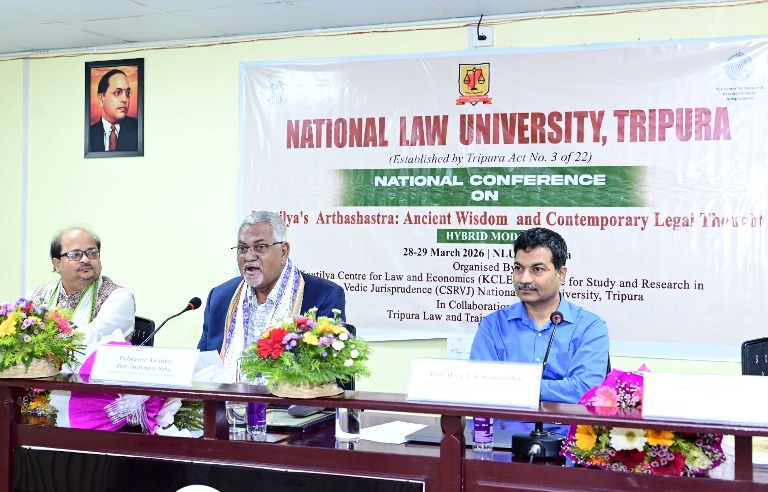
The National Law University (NLU), Tripura, successfully concluded a two-day national conference on “Kautilya’s Arthashastra: Ancient Wisdom and Contemporary Legal Thought” held on March 28–29, 2026.
The conference was jointly organized by the Kautilya Centre for Law and Economics and the Centre for Study and Research in Vedic Jurisprudence of NLU Tripura, in collaboration with the Law Department of Tripura and the Tripura Law Training Institute. Conducted in a hybrid format, the event witnessed the presentation of more than 50 research papers from across the country, exploring Kautilya’s ideas in the context of contemporary law, economics, and governance.
The inaugural session began with ceremonial lamp lighting followed by the chanting of Vande Mataram. Vice-Chancellor Prof. (Dr.) Yogesh Pratap Singh, in his welcome address, highlighted the significance of indigenous knowledge systems. Drawing parallels between the Arthashastra and the Directive Principles of the Constitution of India, he underscored the importance of welfare-oriented governance.
Chief Guest Padma Shri Prof. Arunoday Saha, former Vice-Chancellor of Tripura University, emphasized the need to strike a balance between ethics and economic policy, urging young scholars to blend academic knowledge with practical wisdom. Conference convener Dr. Bandita Sengupta, Assistant Professor of Law, delivered the vote of thanks.
Among the distinguished speakers, Prof. V. K. Ahuja, Director of the Indian Law Institute (ILI), New Delhi, spoke on welfare state principles, focusing on economic regulation, transnational relations, and the protection of vulnerable sections. Delivering the keynote address, Prof. T. S. Somashekhar of the National Law School of India University, Bengaluru, analyzed the Arthashastra through a legal and economic lens, drawing comparisons with modern theories of Adam Smith, Ronald Coase, and Gary Becker on regulation, punishment, and market efficiency.
The conference featured multiple technical sessions and concluded with deliberations aimed at integrating classical Indian knowledge systems into modern policy frameworks. Participants noted that Kautilya’s vision of governance—rooted in welfare, accountability, and pragmatic statecraft—continues to resonate with the principles enshrined in the Constitution of India.
The event successfully bridged the gap between ancient wisdom and contemporary challenges in law, economics, and governance.