
The newly-elected Bharatiya Janata Party government in Bengal has inherited both a mandate and a moment. To build great dreams of development, industrial reconstruction and transparent governance, it must now go all out and make the changes the state has been waiting for.
The current dispensation must address expectations that lay unmet for more than five decades — buried under militant trade unionism, rampant political extortion and a stubborn absence of forward-looking policy.
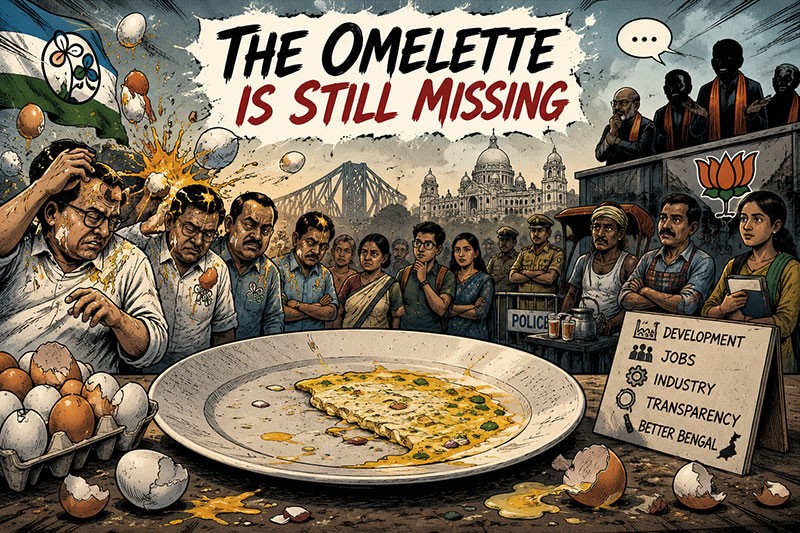
The irony, then, is hard to miss. The egg — that humble symbol of nourishment and new beginnings — has become Bengal's projectile of choice for political protest. People want the omelette on the platter. They are still waiting.
The 'Egg Therapy' Season
Defeated Trinamool Congress second-in-command Abhishek Banerjee, former state sports minister Arup Biswas, TMC spokesperson and freshly-elected Beleghata legislator Kunal Ghosh, former Bidhannagar civic body mayor Sabyasachi Dutta — the list of TMC leaders facing public egg-pelting on Kolkata's busy streets grows longer by the week. In city courts, police stations and public spaces, rotten eggs are being hurled at Trinamool leaders in broad daylight by disgruntled voters who have clearly decided that the ballot was only the first verdict.
The intersection of eggs and politics in Bengal tells two stories at once: public humiliation, and organised dissent against the misdeeds of the erstwhile TMC regime.
Historically, egg-pelting as protest traces its roots to Europe and Great Britain before going global — a low-cost, non-lethal, highly visible expression of outrage that mirrors the perceived fragility of political credibility. In Bengal today, it has become something of a spectator sport, with local residents and rival factions serving up what wags are calling "eggetarian recipes" to the fallen powerful.
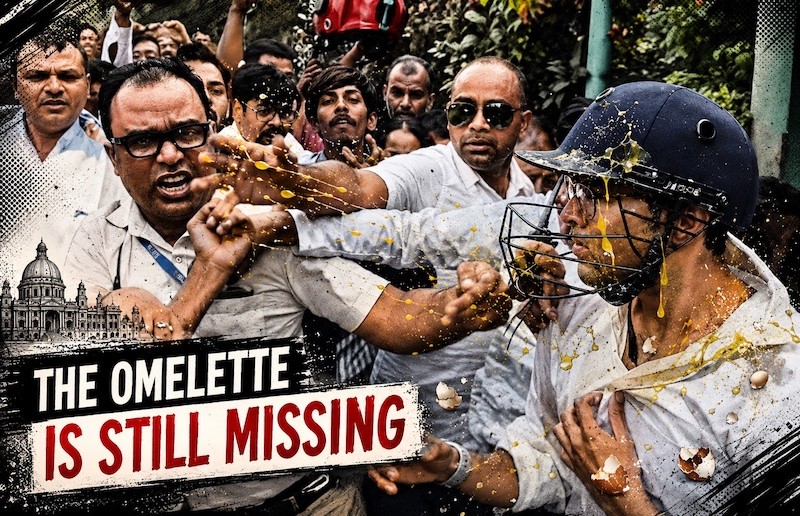 Protestors pelt eggs at the TMC, but the public is still waiting on the real recipe for Bengal's development. Photo: ChatGPT recreation
But Where Is the BJP's Voice?
Here is where the new government must take a hard look at itself. The uncanny silence or sarcastic remarks from the BJP's top rung regarding this sustained public hooliganism is troubling.
That silence—often accompanied by indirect support— lends quiet encouragement to every grassroots opportunist looking to settle scores under the cover of political change. The police, meanwhile, play mute spectators, as though a change of government means a change only in who gets protected, not in the rule of law itself.
The Bengal intelligentsia did not vote for the BJP to watch a new brand of lumpenisation replace the old one. They voted for something rarer and harder: a clean break.
A different political culture. Corruption-free governance. Industrial resurgence. The restoration of Bengal's cultural and intellectual stature. The BJP cannot — must not — replicate the same mode it once condemned.
From Zero to 208 — A Mandate Worth Respecting
When Mamata Banerjee's Trinamool Congress swept to power in 2011, the BJP had virtually zero presence in the state assembly. What followed over fifteen years was one of Indian politics' more remarkable journeys — from nothing to 208 seats, in a state long considered an impenetrable Red Bastion. Quite unbelievable, and yet it happened.
The change happened not just because of RSS-BJP cadres. It happened because of the roadside tea-stall owner, the shopkeeper, the maid, the rickshaw-puller, the small merchant, the teacher, the clerk, the well-read intellectual and the urban elite — all of whom voted silently, without noise or fanfare, for the simple idea of change.
Many of them had once placed the same high hopes in Mamata Banerjee herself.
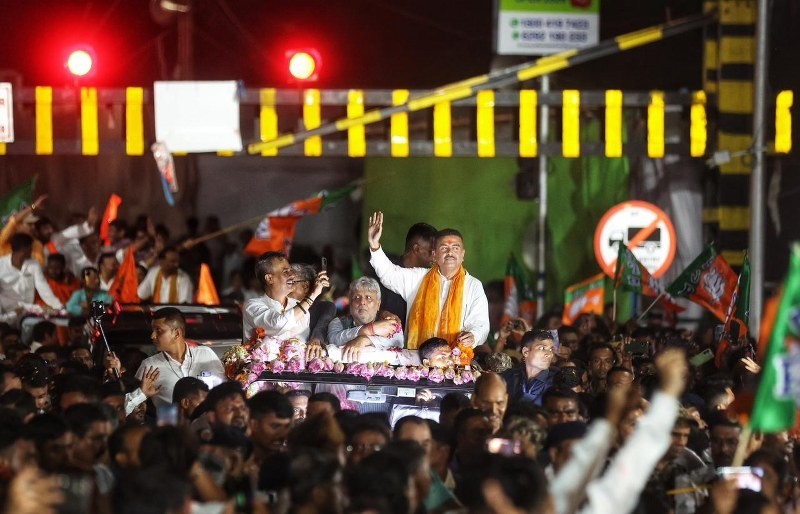 CM Suvendu Adhikari leads victory rally in Bhabanipur after historic Bengal win. Photo: IBNS
The Budget and the Bigger Question
As state Finance Minister Swapan Dasgupta tables the new government's first budget, Bengal's residents are watching closely — and hoping for comprehensive schemes that can genuinely lift the state's economic health. Dasgupta has already met Union Finance Minister Nirmala Sitharaman and NITI Aayog vice-chairman Ashok Kumar Lahiri to discuss a realistic, people-centric fiscal roadmap: attracting investment, generating employment, building a self-reliant Viksit West Bengal.
It is the right conversation to be having. But a state cannot catch up with the national growth momentum while it remains steeped in the dirty theatre of egg-pelting and political score-settling. Bengal has to come out of it — and the BJP must lead that exit, not enable it through silence.
The people gave the saffron party a spectacular mandate. They deserve an omelette, not a food fight.