
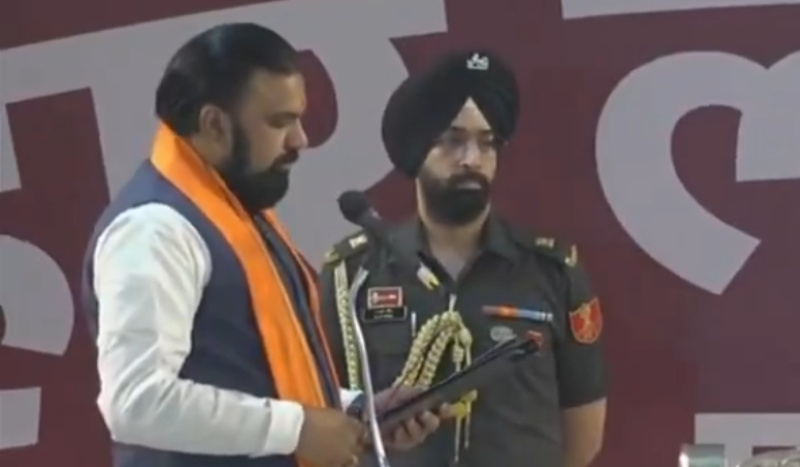
Choudhary was sworn in at Lok Bhawan along with his two deputies — Janata Dal (United) leaders Vijay Kumar Choudhary and Bijendra Prasad Yadav.
He succeeded veteran leader Nitish Kumar and was earlier serving as Deputy Chief Minister in the previous government.
#WATCH | Patna, Bihar: Samrat Choudhary takes oath as the Chief Minister of Bihar
— ANI (@ANI) April 15, 2026
He becomes the first Bharatiya Janata Party (BJP) Chief Minister of Bihar following the resignation of Nitish Kumar. pic.twitter.com/ObDBH2RxJr
Political transition as Nitish era ends
Choudhary’s elevation marks the end of the long-standing political era of Nitish Kumar, who is widely credited for steering development in one of India’s poorest states.
Nitish has now moved to the Rajya Sabha, signalling a major transition in his political career at the age of 75.
एनडीए विधानमंडल दल की बैठक में बिहार के विकास पुरुष माननीय श्री @NitishKumar जी ने माननीय @samrat4bjp जी को एनडीए विधानमंडल दल का नेता बनाने का प्रस्ताव रखा, जिसे सर्वसम्मति से स्वीकार किया गया।
— BJP Bihar (@BJP4Bihar) April 14, 2026
इस निर्णय के साथ बिहार अब और अधिक मजबूती, स्थिरता और तेज़ गति से विकास की दिशा में… pic.twitter.com/8RFg1WNs3n
BJP expands footprint in Hindi heartland
With this development, Bihar joins states like Uttar Pradesh, Madhya Pradesh, Rajasthan, Chhattisgarh, Uttarakhand and Haryana, where the BJP is in power with its own CM.
Bihar had remained a key exception despite the BJP being part of ruling alliances for nearly two decades, barring brief interruptions.
Who is Samrat Choudhary?
Samrat Choudhary, 57, belongs to the Koeri or Kushwaha community, a significant Other Backwards Class (OBC) group in Bihar with considerable political influence.
He began his political career in 1990 and has been associated with multiple parties, including the Rashtriya Janata Dal (RJD) and the Janata Dal (United), before joining the BJP in 2017.
Choudhary had emerged as a leading contender for the Chief Minister’s post in recent months, with indications from Nitish Kumar during public engagements signalling support for his leadership.
Political balance in Bihar
In the 243-member Bihar Assembly, Nitish Kumar’s party holds 85 seats, closely trailing the BJP’s strength, reinforcing the latter’s position in the current political arrangement.
The leadership shift marks a significant moment in Bihar’s political trajectory, with the BJP now directly heading the state government.