
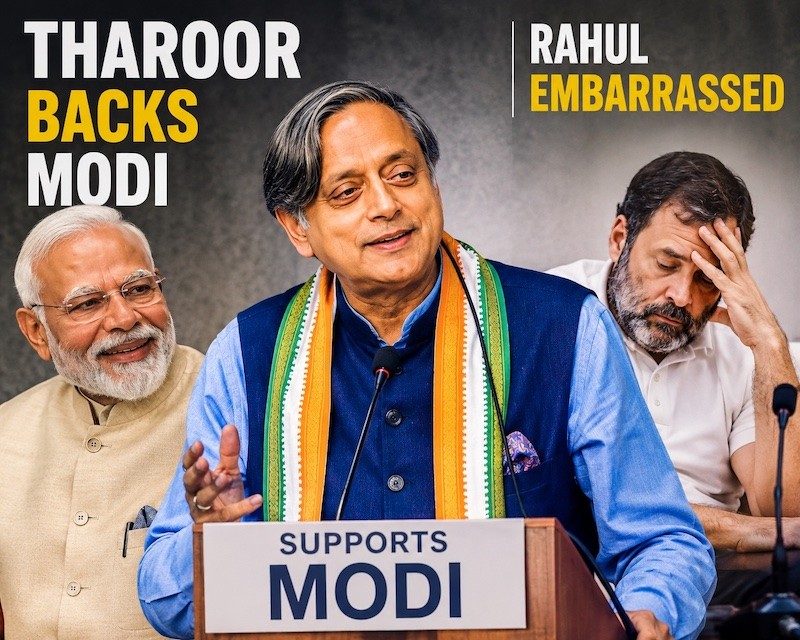
The Congress had spent days hammering Modi for alleged silence over the deaths of three Indian seafarers killed in a US strike on a merchant vessel in the Gulf of Oman.
The opposition demanded accountability, an apology from Washington, and a public reckoning from the Prime Minister. Then Tharoor, Congress MP and Chairman of the Parliamentary Standing Committee on External Affairs, walked up to a microphone and said, in effect: Modi got it right.
Speaking to IANS in an exclusive interview, Tharoor said the Prime Minister "was particularly able to convey a message that we would all agree with, namely that commercial shipping should not be targeted in a war," adding that "pretty much every ship, whatever country's flag is flying, has an Indian crew on board."
He went further. Tharoor said Modi made India's position clear in both public and private discussions with President Trump, stressing that commercial seafarers should not be targets of combat during wartime — that they are not soldiers. And then came the line that cut through all the political noise: "If they are violating your blockade, find some other way of stopping them, but do not kill people."
That is not a rebuke of Modi. That is a defence of him — and an implicit rebuke of the Congress line.
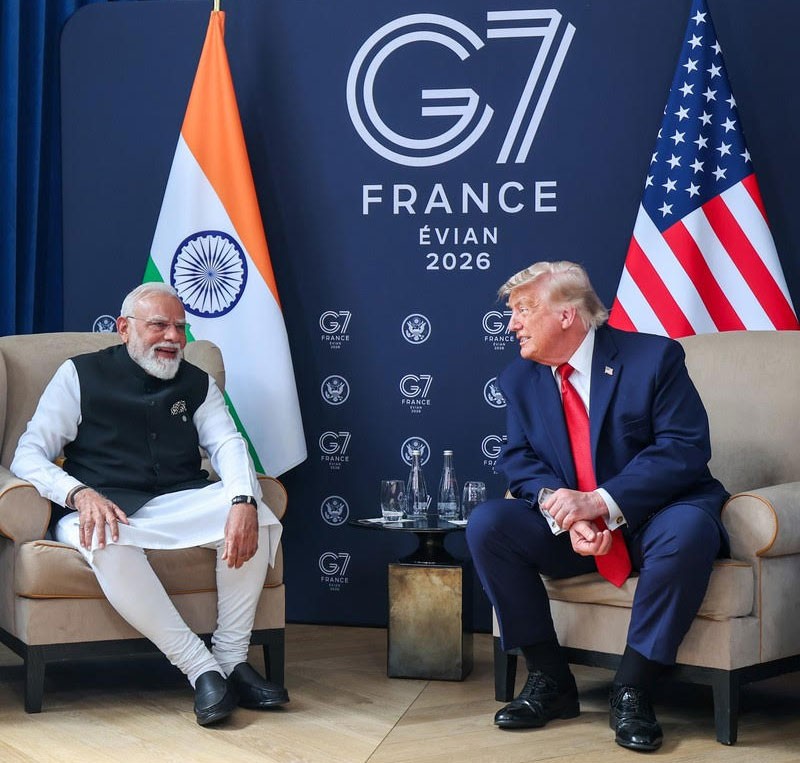 Modi held a bilateral meeting with Trump, on the sidelines of the G7 Summit in France. Photo: PIB
Ammunition for BJP
The BJP, predictably, pounced. Spokesperson Pradeep Bhandari posted on X that Tharoor had "exposed Rahul Gandhi," claiming that Congress leaders were "openly praising PM Modi's diplomacy" while the Leader of Opposition was busy "speaking against India's national interest." It was blunt, partisan, and — for the BJP — entirely fair game.
Shashi Tharoor exposes Rahul Gandhi.
— Pradeep Bhandari(प्रदीप भंडारी)🇮🇳 (@pradip103) June 20, 2026
Congress Leader praises PM @narendramodi Ji’s diplomacy.
When it Comes to Protecting India's National Interest PM Modi comes first;
When it comes to speaking against India's National interest Rahul Gandhi leaves everyone behind! pic.twitter.com/zJIr5RiTRh
The bilateral between Modi and Trump, their first in 16 months, covered significant ground. Modi raised concerns about the security of Indian seafarers operating not only near the Strait of Hormuz but across the entire Gulf region, noting that lakhs of Indians work as seafarers and that their safety remains a key priority. Trump, for his part, called Modi a "good-looking guy" and a "tough negotiator" — compliments that, coming from Trump, double as a geopolitical signal.
The episode underlines a recurring tension within the Congress: a party that speaks with one voice on most issues but occasionally finds its most prominent internationalist voices operating on a different frequency from its political leadership. Tharoor has been here before — praising a Modi initiative, triggering a BJP news cycle, and leaving the party to manage the fallout.
This time, the issue is life and death. Indian sailors in contested waters. A US strike. Grieving families. And a Prime Minister whose critics say he stayed silent in public while his defenders — including now one of Congress's own — say he did what diplomacy required, quietly and effectively.
The truth, as always in such moments, probably lives somewhere between the outrage and the endorsement. But in the court of political perception, Tharoor has spoken. And the BJP is not wasting a word of it.